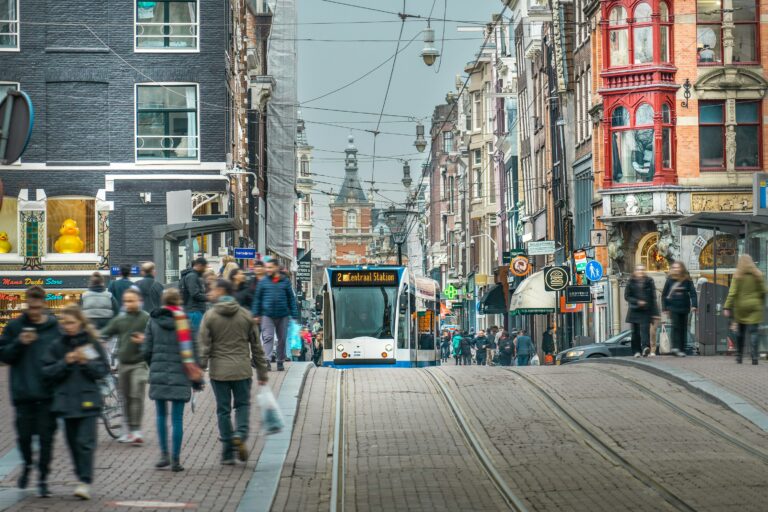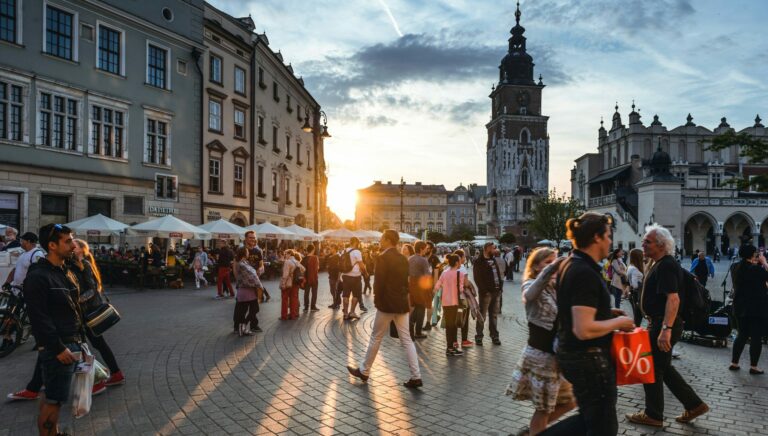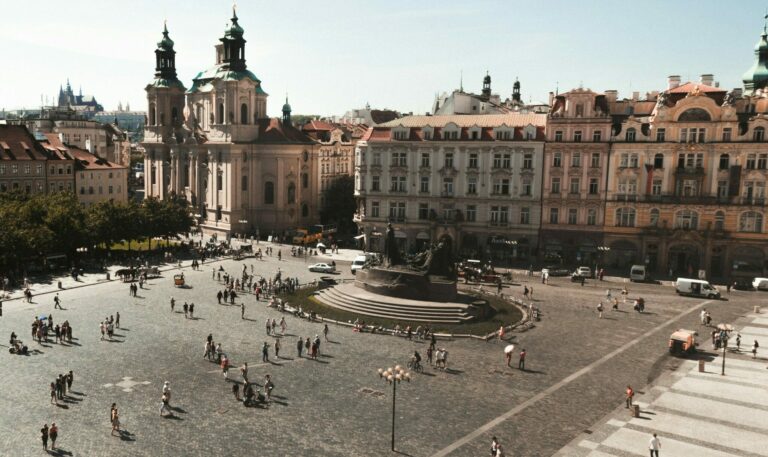









Choosing the right location is a key decision in retail expansion. Often, the busiest places are not always the most obvious. To support more confident retail site selection, this article ranks Belgium’s top footfall spots using Targomo’s 2025 foot traffic data.
The analysis is split into three top 10 rankings. First, we identify the busiest street-level locations in Belgium, with the highest average daily pedestrian flows. Second, we look specifically at tourist footfall, highlighting the places with the highest tourist flow. For both of these rankings, each figure refers to the busiest measured point in a small area, such as a street segment, square or intersection within roughly a 20-metre radius. The mall ranking uses a different metric: total average daily visitors across each shopping centre.
Jump to:
Top 10 Footfall Spots in Belgium by Daily Pedestrian Traffic
The strongest pedestrian volumes in Belgium are concentrated in Brussels and Antwerp, with Rue du Marché aux Herbes and Meir alone accounting for the top two positions and Antwerp returning twice more via Grote Markt and De Keyserlei. Beyond the two dominant cities, the ranking highlights meaningful activity in Ghent’s Korenmarkt, Bruges’ Steenstraat, and Liège’s Place de la Cathédrale, confirming that secondary cities carry genuine retail weight. For expansion teams, this ranking pinpoints exactly where daily pedestrian movement peaks at street and junction level, from the crossroads at Rue du Marché aux Herbes to the mid-section of Meir, giving site selectors a precise starting point rather than a broad city-level estimate.
| City | Place | Daily Footfall |
|---|---|---|
| Brussels | Rue du Marché aux Herbes (Grasmarkt) | 47,410 |
| Antwerp | Meir | 42,290 |
| Ghent | Korenmarkt | 32,170 |
| Bruges | Steenstraat | 28,900 |
| Antwerp | Grote Markt | 19,020 |
| Antwerp | De Keyserlei | 17,920 |
| Ostend | Kapellestraat | 17,320 |
| Liège | Place de la Cathédrale | 17,300 |
| Brugelette | Pairi Daiza | 15,470 |
| Namur | Rue de Fer | 14,830 |
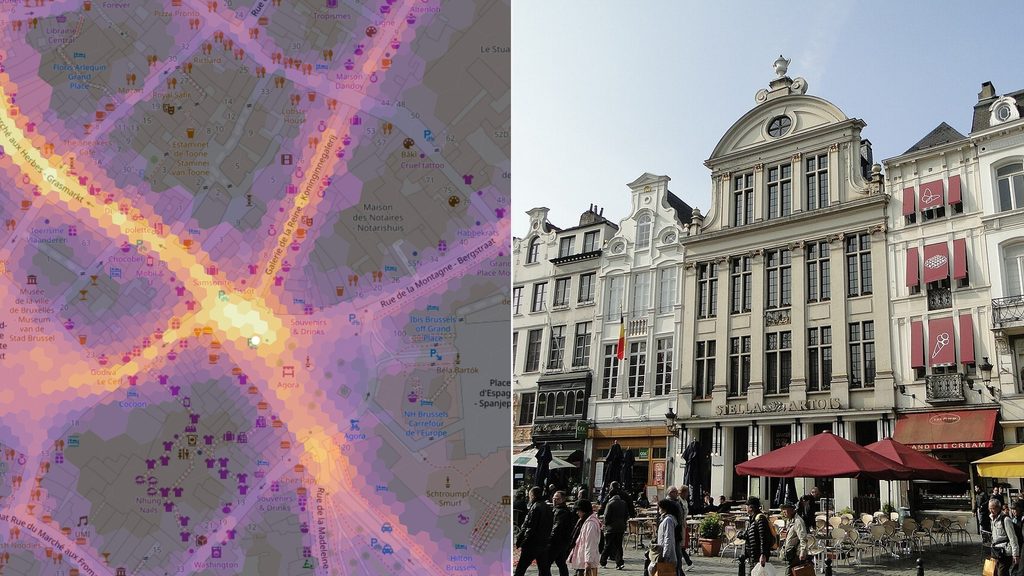
1. Rue du Marché aux Herbes (Grasmarkt), Brussels: 47,410 Daily Footfall
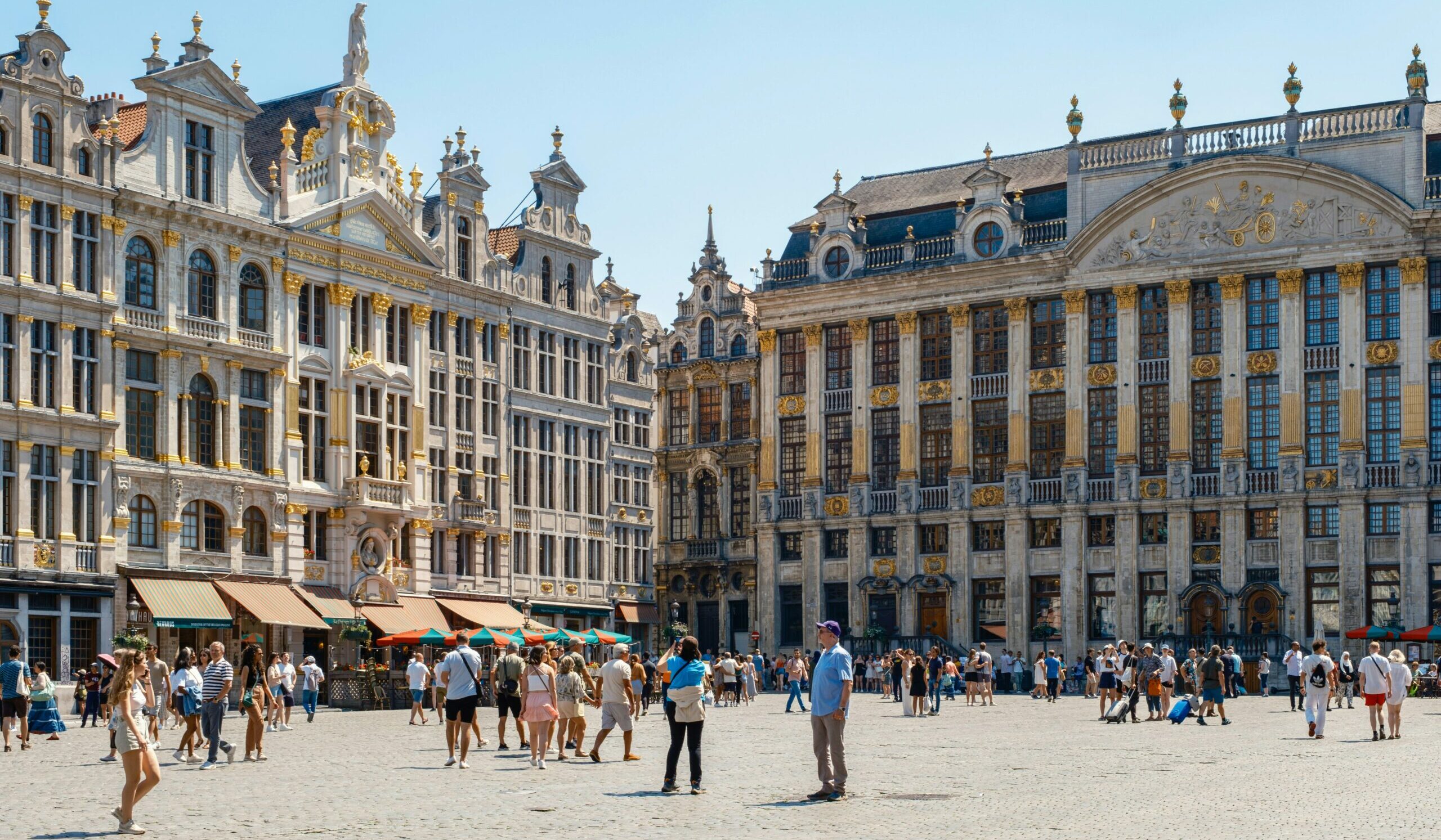
Rue du Marché aux Herbes (Grasmarkt) is one of Brussels’ busiest pedestrian thoroughfares, connecting the Grand Place (Grote Markt) to the Royal Galleries of Saint-Hubert. The peak footfall concentration sits at the crossroads where Rue du Marché aux Herbes meets the entrance to the Galerie de la Reine (Koninginnegalerij), a junction that funnels pedestrians arriving from multiple directions through the city centre. With more than 47,000 people recorded passing through, this stretch draws a steady stream of pedestrians throughout the day, drawn by the density of shops, cafés, and the proximity to landmarks such as the Samsonite flagship store and the Godiva boutique on Rue au Beurre. The data firmly underlines the role of this corridor as the beating heart of retail and leisure movement in the Belgian capital.
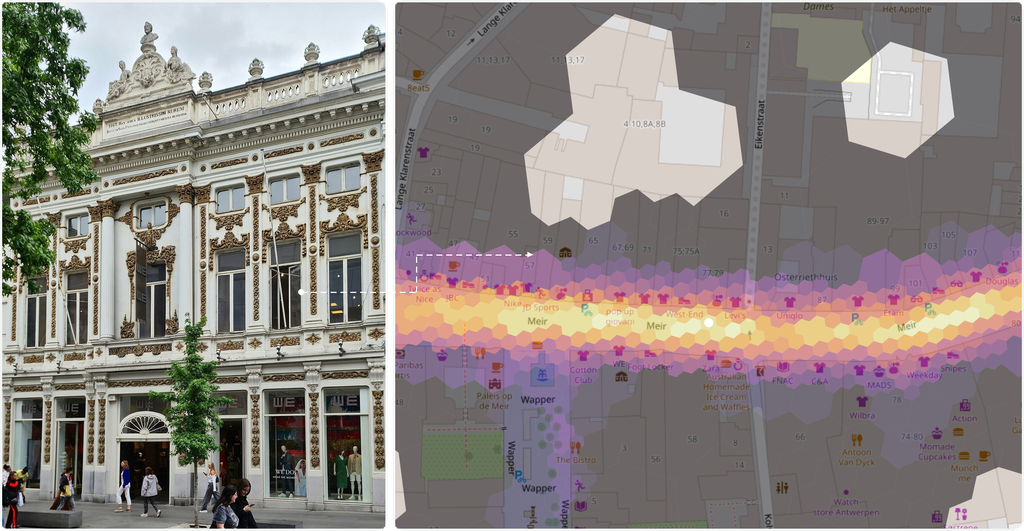
2. Meir, Antwerp (Antwerpen): 42,290 Daily Footfall
Meir is Antwerp’s main pedestrian shopping street, running through the heart of the city centre and lined with a dense mix of international retailers including Zara, Uniqlo, FNAC, and Foot Locker. The peak footfall concentration sits around the mid-section of the street, near the Levi’s store at number 83, roughly where Meir intersects with Eikenstraat — a stretch flanked by West-End and JD Sports that draws a continuous flow of pedestrians throughout the day. Close to the Wapper square and the Rubens House (Rubenshuis), this part of the street benefits from both retail draw and cultural proximity. With more than 42,000 people counted passing through, Meir firmly establishes itself as Antwerp’s premier high street destination.
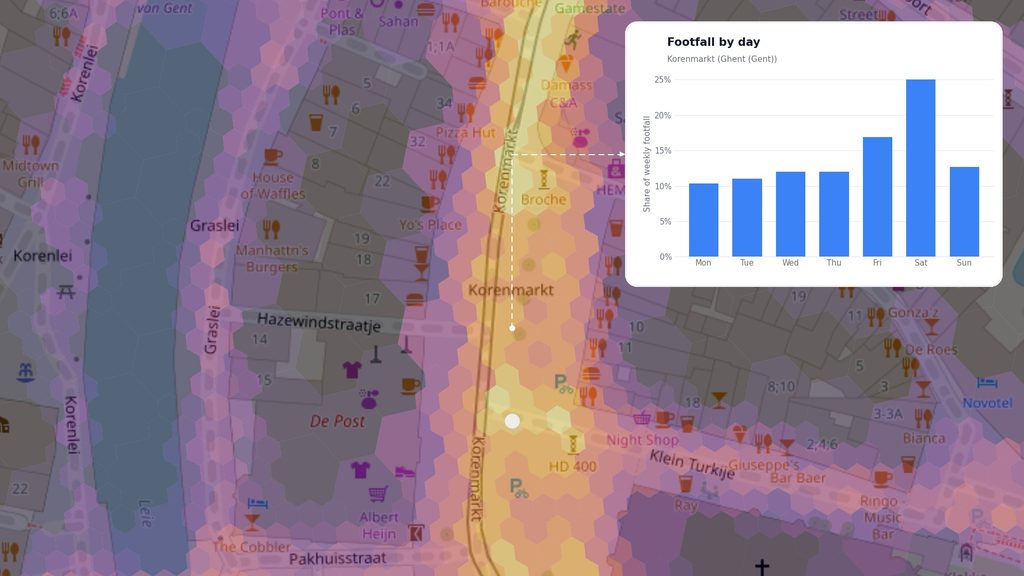
3. Korenmarkt, Ghent: 32,170 Daily Footfall
Korenmarkt is Ghent’s central pedestrian artery, running north from the Gent-Korenmarkt tram stop towards the Graslei and Korenlei waterfront quays. The busiest stretch sits along the mid-section of Korenmarkt itself, just west of Klein Turkije, where foot traffic funnels through the corridor connecting the city’s historic core to its main retail streets such as Veldstraat. Nearby landmarks including Sint-Niklaaskerk and the De Post building anchor the area as both a civic and commercial crossroads. With more than 32,000 people counted passing through, this stretch confirms Korenmarkt’s role as the central nervous system of pedestrian movement in Ghent.
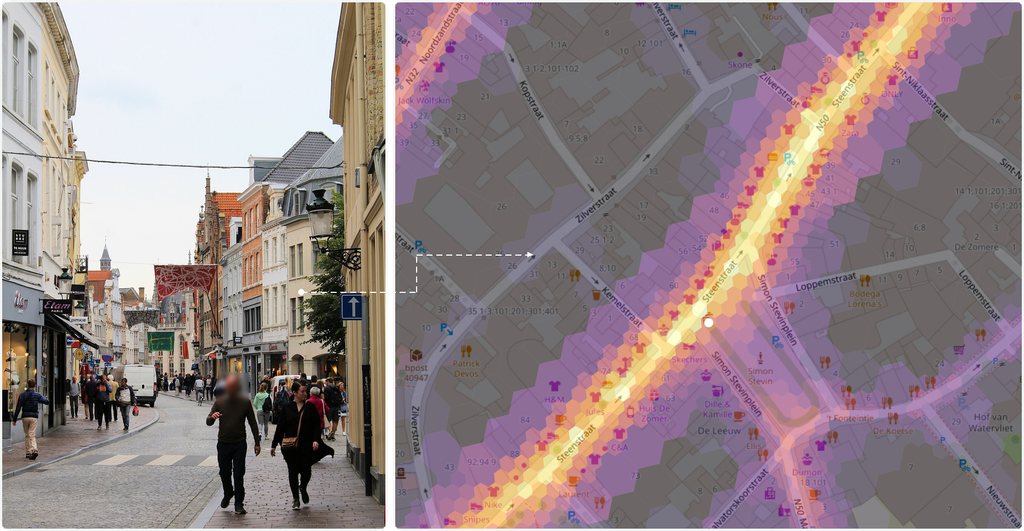
4. Steenstraat, Bruges: 28,900 Daily Footfall
Steenstraat is Bruges’ main retail spine, running southeast from the Markt towards Simon Stevinplein and drawing a steady flow of pedestrians past high-street names such as H&M, C&A, Nike, and Skechers. The busiest point on the street falls at the junction with Kemelstraat and Simon Stevinplein, where foot traffic converges from several directions at once. This crossroads also sits within easy reach of Sint-Salvatorskathedraal, adding a cultural draw to the commercial pull of the surrounding shops. With close to 29,000 people counted passing through, Steenstraat confirms its place as the commercial backbone of pedestrian movement in the city centre.
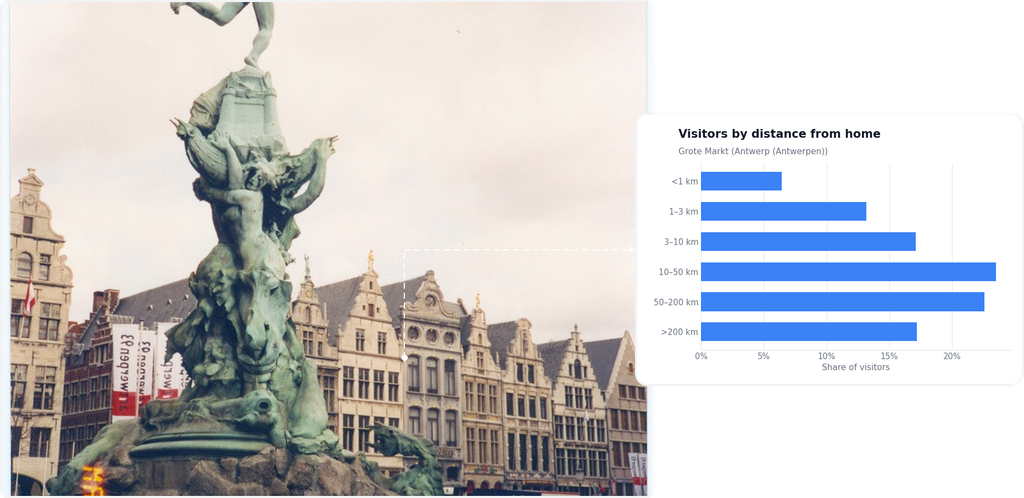
5. Grote Markt, Antwerp: 19,020 Daily Footfall
Antwerp’s Grote Markt already featured prominently in this ranking via the Meir entry, but the data show it drawing substantial foot traffic in its own right. The peak concentration falls at the western end of Gildekamersstraat where it meets Suikerrui, right at the edge of the square itself — a natural convergence point where pedestrians moving between the Scheldt waterfront and the city centre funnel together. With close to 19,000 people counted passing through, the area around the Stadhuis (City Hall) and the guild houses confirms that Grote Markt functions as much more than a scenic backdrop, remaining a genuinely busy node in Antwerp’s pedestrian network.
6. De Keyserlei, Antwerp: 17,920 Daily Footfall
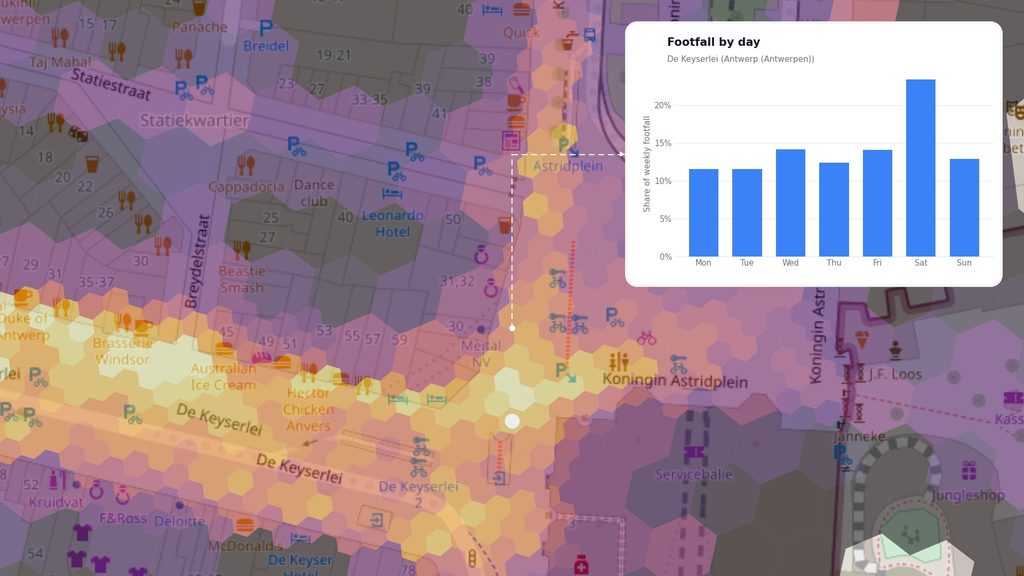
De Keyserlei is a broad commercial boulevard connecting Antwerp Central Station (Antwerpen-Centraal) to the Meir shopping street, lined with hotels, fast-food chains, and retail outlets that keep foot traffic moving steadily throughout the day. The busiest point falls along the mid-section of De Keyserlei, roughly where it passes the De Keyser Hotel and approaches the junction with Koningin Astridplein — a natural funnel for pedestrians arriving from or heading towards the station. The proximity of Koningin Astridplein, one of Antwerp’s main public transport hubs, ensures a constant throughflow of commuters, shoppers, and passersby. With close to 18,000 people counted passing through, De Keyserlei functions as a key transitional corridor between the station district and the city’s primary retail core.
7. Kapellestraat, Ostend: 17,320 Daily Footfall
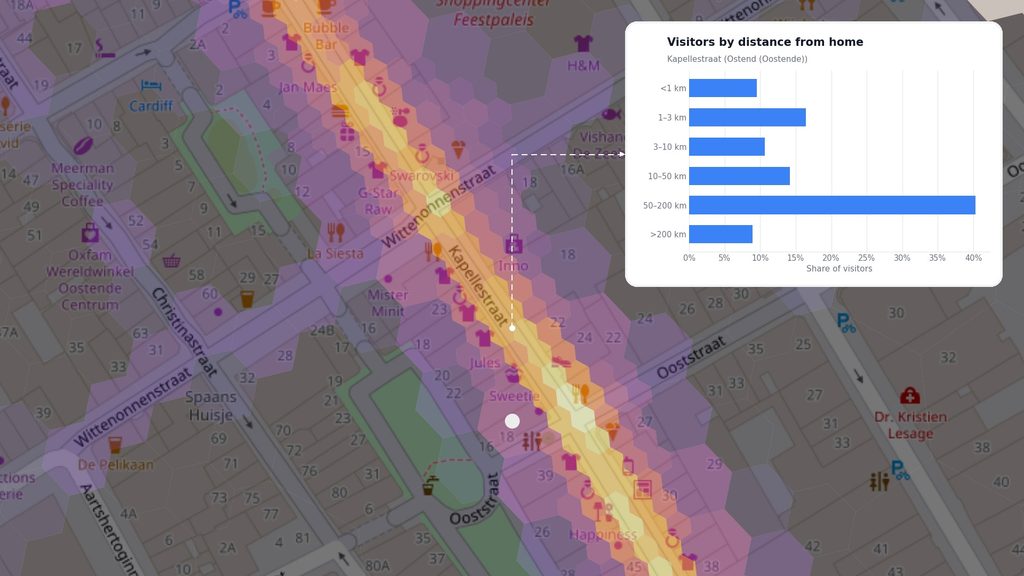
Kapellestraat is Ostend’s main pedestrian shopping street, running through the heart of the city centre and lined with a mix of high-street retailers including C&A, Hunkemöller, Inno, and Foot Locker. The busiest stretch falls along the mid-section of the street, roughly between its junctions with Ooststraat and Sint-Paulusstraat, where foot traffic from the surrounding grid of streets converges into a single corridor. The nearby Shoppingcenter Feestpaleis adds further retail draw to the northern end of the street, keeping pedestrian flows steady throughout the day. With more than 17,000 people counted passing through, Kapellestraat confirms its role as the commercial backbone of Ostend’s city centre.
8. Place de la Cathédrale, Liège: 17,300 Daily Footfall
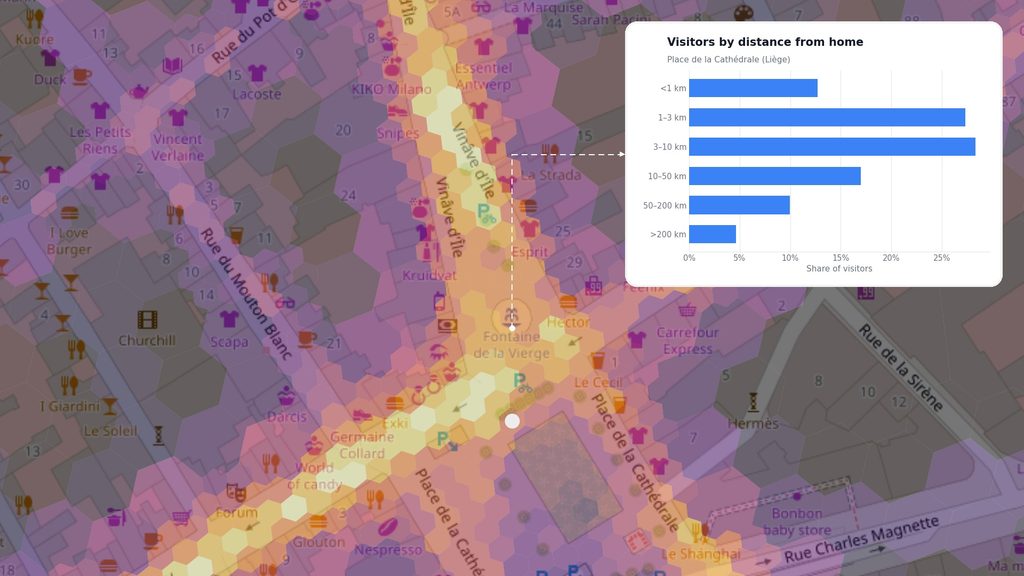
Place de la Cathédrale sits at the heart of Liège’s pedestrian shopping district, where Vinave d’Île — the city’s main retail artery — converges with Rue de la Cathédrale and several surrounding streets. The busiest spot falls at the northern end of the square, right at the point where Vinave d’Île meets Place de la Cathédrale, funnelling pedestrians moving between the Passage Lemonnier area and the city’s broader retail core. Retailers such as Zara, Kruidvat, and Nespresso line the immediate surroundings, while the Cathédrale Saint-Paul anchors the southern edge of the area. With around 17,000 people counted passing through, the square functions as a key junction in Liège’s pedestrian network.
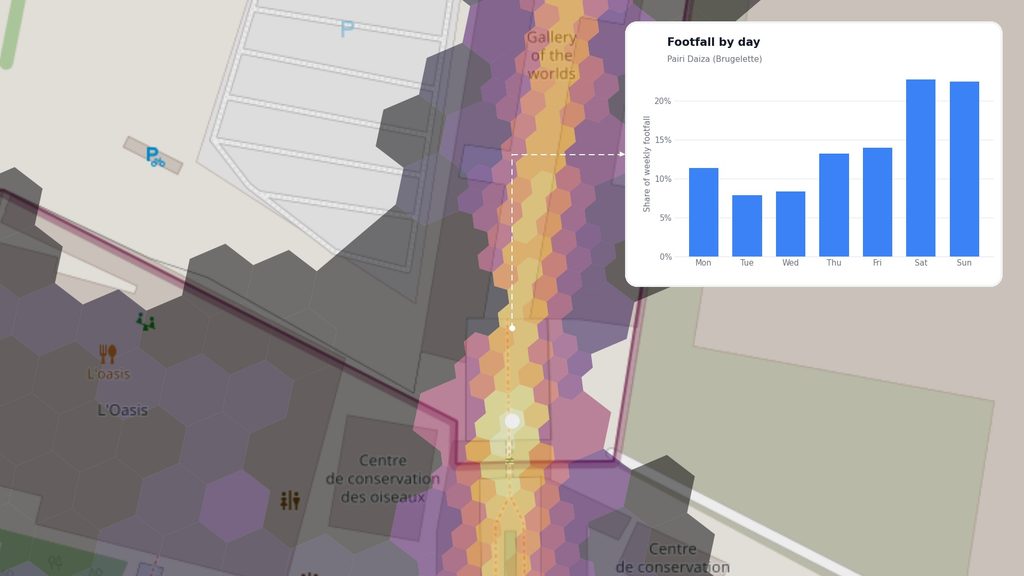
9. Pairi Daiza, Brugelette: 15,470 Daily Footfall
Pairi Daiza is one of Belgium’s most popular zoo and botanical garden complexes, spread across a sprawling estate in the Hainaut countryside near Brugelette. The peak footfall falls along the main central pathway leading from the Gallery of the Worlds towards the park’s iconic circular plaza, a natural thoroughfare that channels pedestrians past enclosures including the Dromadaire area and the Panda habitat housing Tian Bao, Bao Di, and Bao Mei. This central spine connects the park’s key attractions and effectively acts as its pedestrian backbone. With around 15,000 people counted passing through, the data reflect the sustained draw of this destination well beyond the urban retail locations that dominate the rest of this ranking.
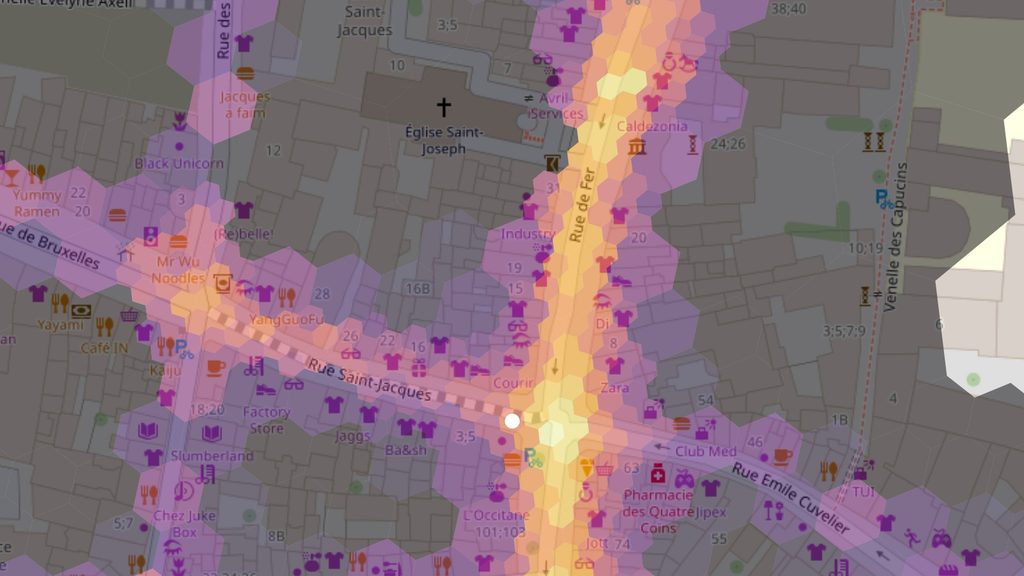
10. Rue de Fer, Namur: 14,830 Daily Footfall
Rue de Fer is Namur’s main pedestrian shopping street, running through the city centre and connecting the upper retail district around Rue Saint-Jacques to the Place de l’Ange further south. The hottest point on the street falls at the junction where Rue de Fer crosses Rue Saint-Jacques, a natural convergence where foot traffic from several directions merges into a single corridor lined with retailers such as Zara, L’Occitane, and Okaidi. Place de l’Ange, a short distance to the south, adds further pull by anchoring the lower end of the street near HEMA and Kruidvat. With around 15,000 people counted passing through, Rue de Fer confirms its role as the commercial spine of pedestrian movement in the Walloon capital.
Top 10 Tourist Hotspots by Foot Traffic in Belgium
These locations rank by tourist footfall — pedestrians who live more than 50 kilometres away. Only places where tourists account for at least 70% of total footfall are included, to surface destinations with a genuinely tourist-driven pedestrian profile.
Belgium’s tourist footfall is heavily concentrated in its two headline cities, with Manneken Pis in Brussels and the Markt in Bruges together accounting for the highest pedestrian counts by a clear margin. Beyond those anchors, the ranking reveals that the Belgian coast dominates the remainder of the list, with Blankenberge’s Kerkstraat, Ostend’s Visserskaai and Albert I Promenade, and a string of resort streets from De Panne to Knokke-Heist all drawing thousands of tourist pedestrians through tightly defined corridors. For expansion teams, the ranking identifies the precise streets and junctions — from Rue du Chêne in Brussels to Zeelaan in Koksijde — where tourist-facing retail and hospitality concepts will encounter the highest concentration of out-of-town visitors, making it a practical tool for prioritising site selection along Belgium’s coastal strip and in its two most-visited cities.
| City | Place | Daily Footfall | Daily Tourist Footfall |
|---|---|---|---|
| Brussels | Manneken Pis, Rue du Chêne (Eikstraat) | 20,450 | 14,650 |
| Bruges | Markt, Bruges | 17,160 | 13,010 |
| Blankenberge | Kerkstraat, Blankenberge | 13,850 | 10,230 |
| Ostend | Visserskaai, Ostend | 9,180 | 7,130 |
| Ostend | Albert I Promenade, Ostend | 7,940 | 6,040 |
| De Panne | Zeelaan, De Panne | 6,110 | 5,290 |
| Koksijde | Zeelaan, Koksijde | 5,820 | 5,020 |
| Knokke-Heist | Lippenslaan, Knokke-Heist | 6,130 | 4,660 |
| Middelkerke | Zeedijk, Middelkerke | 5,060 | 4,290 |
| Nieuwpoort | Albert I Laan, Nieuwpoort | 5,350 | 3,880 |
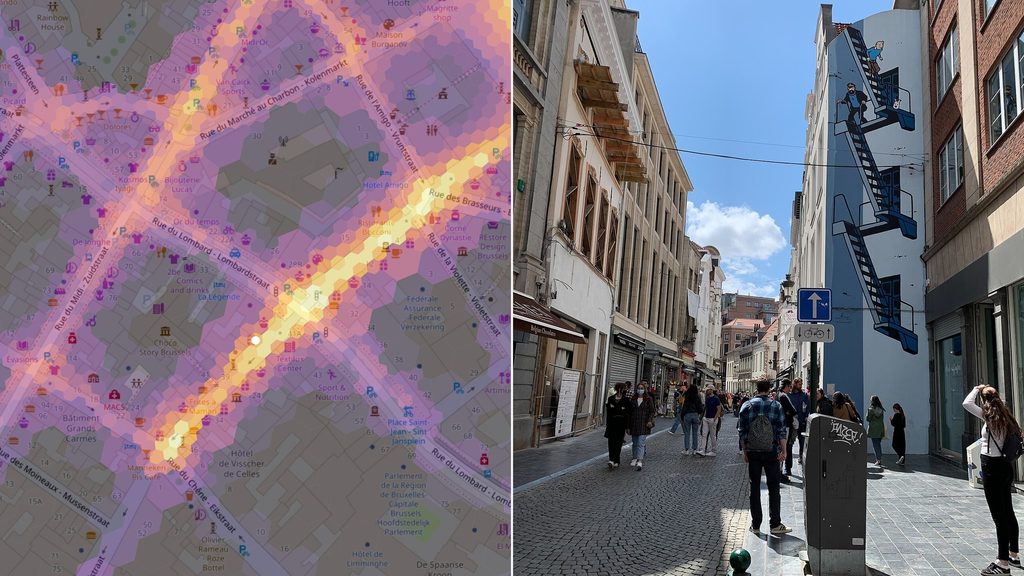
1. Manneken Pis, Rue du Chêne (Eikstraat), Brussels: 14,650 Daily Tourists
The peak footfall falls on Rue du Chêne just in front of the Manneken Pis statue, where pedestrians converge from Rue du Lombard and the surrounding streets of the lower city. Few spots in Belgium concentrate tourist footfall quite so reliably: the small bronze figure draws a steady stream of people throughout the day, positioned just a short walk from the Grand Place (Grote Markt) and within easy reach of Choco Story Brussels and the Frites à Maman snack bar. The surrounding streets funnel foot traffic naturally towards this corner, making it a genuine pedestrian hotspot despite — or perhaps because of — the statue’s modest scale.
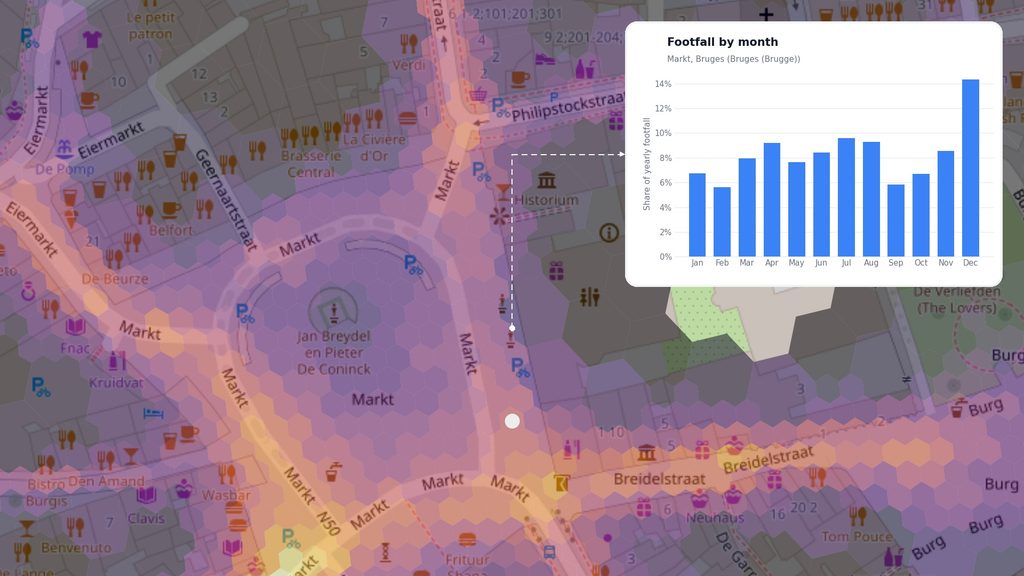
2. Markt, Bruges, Bruges: 13,010 Daily Tourists
The Markt is Bruges’ central square and the natural starting point for anyone exploring the city, framed by the medieval Belfort tower, the Provincial Court, and a ring of gabled guild houses. The peak footfall sits in the southern half of the square, near the junction with Breidelstraat — the narrow lane that leads directly towards the Burg square and the Basilica of the Holy Blood. Chocolate shops, lace boutiques, and horse-drawn carriages keep the square busy throughout the day, drawing a steady flow of pedestrians from across the city. With more than 13,000 tourist footfalls counted, the Markt firmly establishes itself as the heart of Bruges’ tourist circuit.
3. Kerkstraat, Blankenberge: 10,230 Daily Tourists
Kerkstraat is Blankenberge’s main pedestrian shopping street, running diagonally through the town centre and connecting the seafront district to the broader retail grid inland. The busiest stretch falls along the mid-section of the street, around the junction with Molenstraat, where foot traffic converges from several directions at once. Blankenberge draws large numbers of day-trippers and holidaymakers from across Belgium, particularly in summer, and Kerkstraat channels much of that movement past a dense mix of clothing retailers, snack bars, and souvenir shops. With more than 10,000 tourist pedestrians counted passing through, the street clearly functions as the central artery of the town’s seasonal footfall.
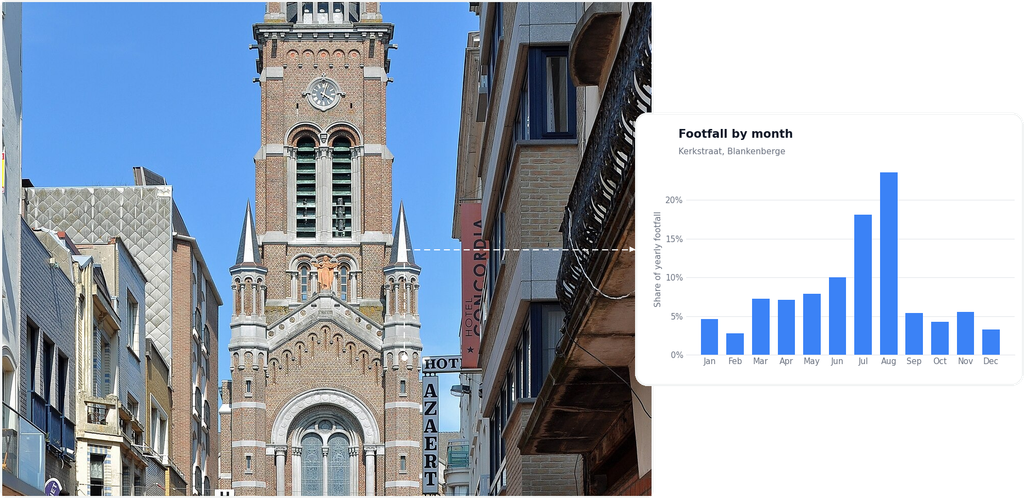
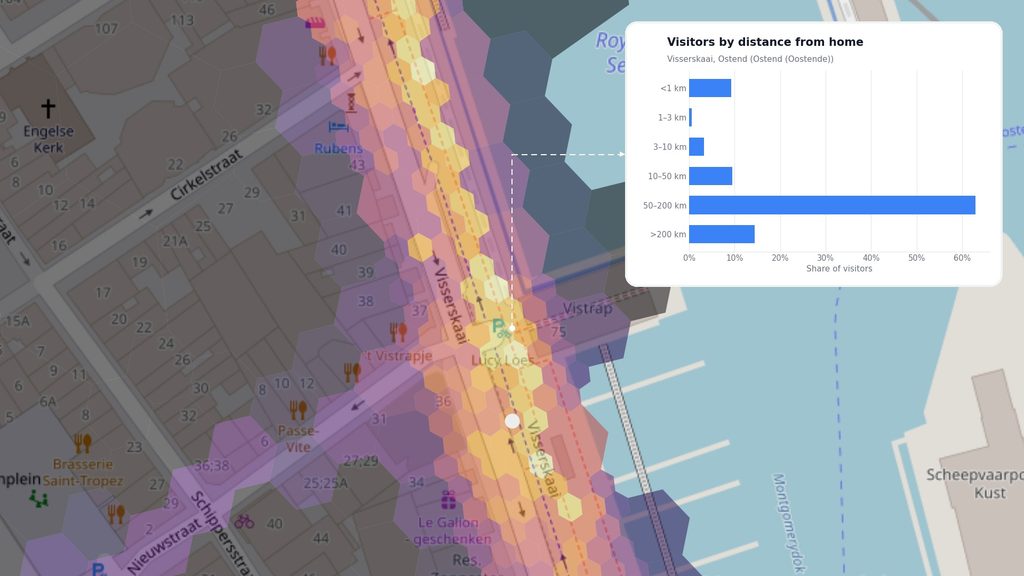
4. Visserskaai, Ostend, Ostend: 7,130 Daily Tourists
Visserskaai is Ostend’s harbourfront promenade, running along the edge of the Montgomerydok and lined with fish restaurants, seafood stalls, and souvenir shops that draw a steady flow of day-trippers and coastal holidaymakers. The busiest stretch falls along the mid-section of the quay, roughly between the Vistrap fish market and Vissersplein, where pedestrians pause to browse fresh catch at the open-air stalls or settle into one of the many waterside eateries. The combination of an active working harbour, the nearby Scheepvaartpolitie Kust building, and the raw coastal atmosphere gives the quay a character that sets it apart from the retail-focused streets that dominate much of this ranking. With more than 7,000 tourist pedestrians counted passing through, Visserskaai captures the more relaxed, seaside-oriented side of Belgian tourist footfall.
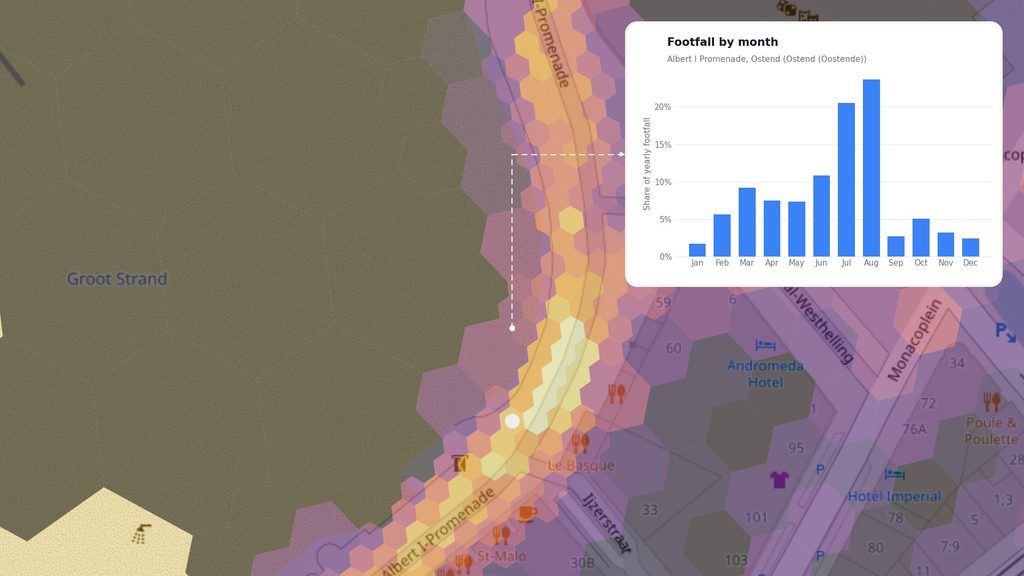
5. Albert I Promenade, Ostend: 6,040 Daily Tourists
The Albert I Promenade runs along Ostend’s seafront, tracing the edge of the Groot Strand and drawing a steady flow of pedestrians between the beach and the city’s broader coastal strip. The peak footfall falls at the point where the promenade meets IJzerstraat, just in front of Le Basque and within sight of the Kursaal convention centre — a natural crossroads where people moving along the seafront intersect with those heading inland from the beach. The proximity of the Andromeda Hotel and a cluster of seafront restaurants keeps this stretch busy throughout the day, particularly with day-trippers drawn to the coast. With more than 6,000 tourist pedestrians counted passing through, the data confirm that Ostend’s seafront promenade pulls a strong leisure crowd well beyond the retail-focused streets that define much of this ranking.
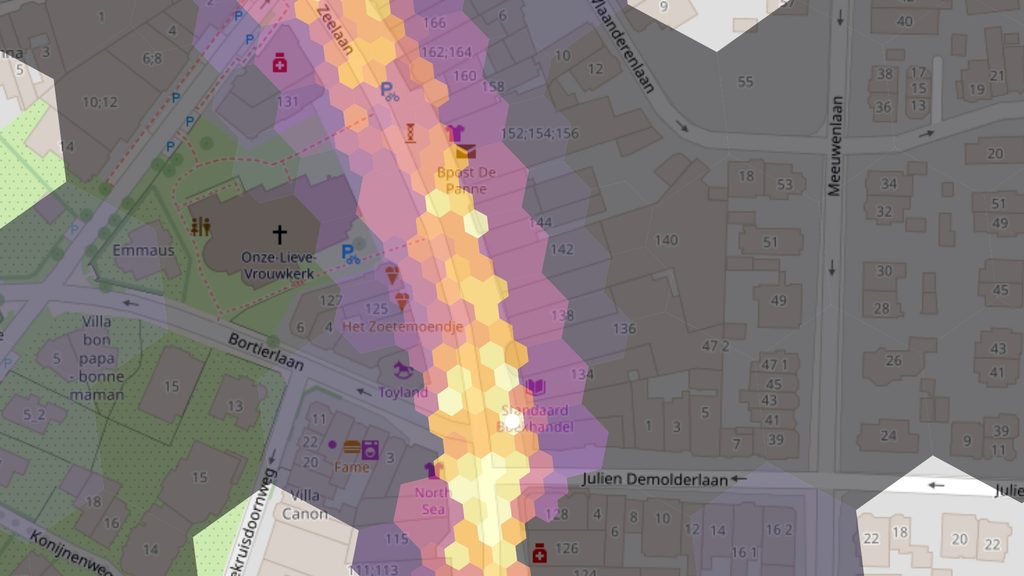
6. Zeelaan, De Panne: 5,290 Daily Tourists
Zeelaan is De Panne’s main pedestrian shopping street, running through the heart of this popular coastal resort town near the French border and the vast sand dunes of Plage de De Panne. The busiest stretch falls along the mid-section of the street, around the junction with Bortierlaan and Julien Demolderlaan, where foot traffic converges from the surrounding residential streets and the wider beach district. Shops such as Standaard Boekhandel, Toyland, and North Sea line the corridor, alongside cafés and ice cream parlours that cater to a predominantly leisure-driven crowd. With more than 5,000 tourist pedestrians counted passing through, Zeelaan captures the relaxed but steady rhythm of a Belgian coastal town that fills up significantly during the holiday season.
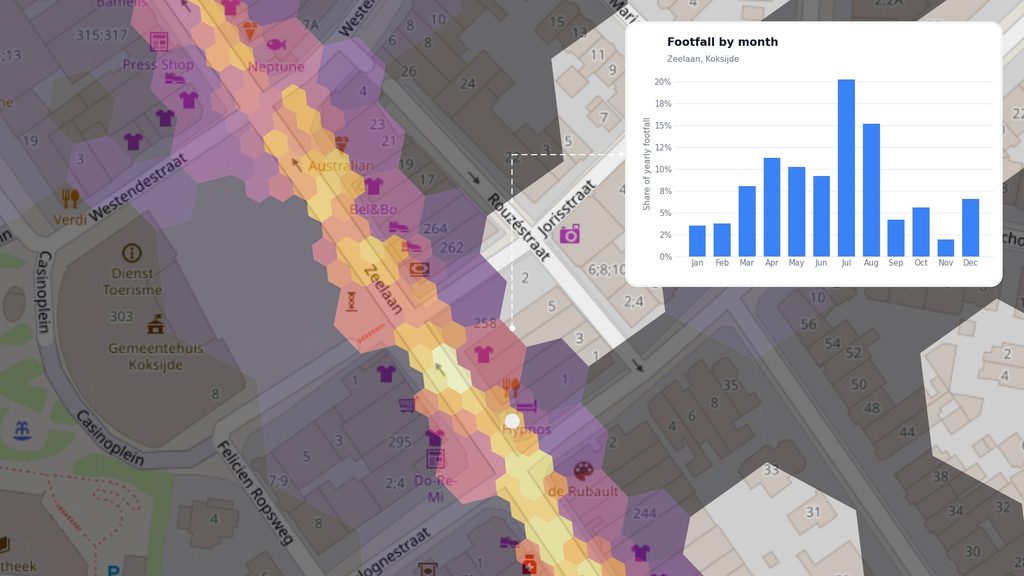
7. Zeelaan, Koksijde: 5,020 Daily Tourists
Zeelaan is Koksijde’s main pedestrian shopping street, stretching through the centre of this popular coastal resort and drawing a steady flow of leisure-driven pedestrians past clothing shops, cafés, and souvenir outlets. The peak concentration falls along the mid-section of the street, near the junction with Boulognestraat and close to the Casinoplein, where foot traffic from the surrounding beach district funnels into a single corridor. Koksijde sits near the vast dunes of the Doornpanne nature reserve and the famous ruins of the Ten Duinen abbey, giving it appeal beyond the purely commercial. With around 5,000 tourist pedestrians counted passing through, Zeelaan reflects the seasonal but reliable rhythm of a Belgian coastal town that comes into its own during the summer months.
8. Lippenslaan, Knokke-Heist: 4,660 Daily Tourists
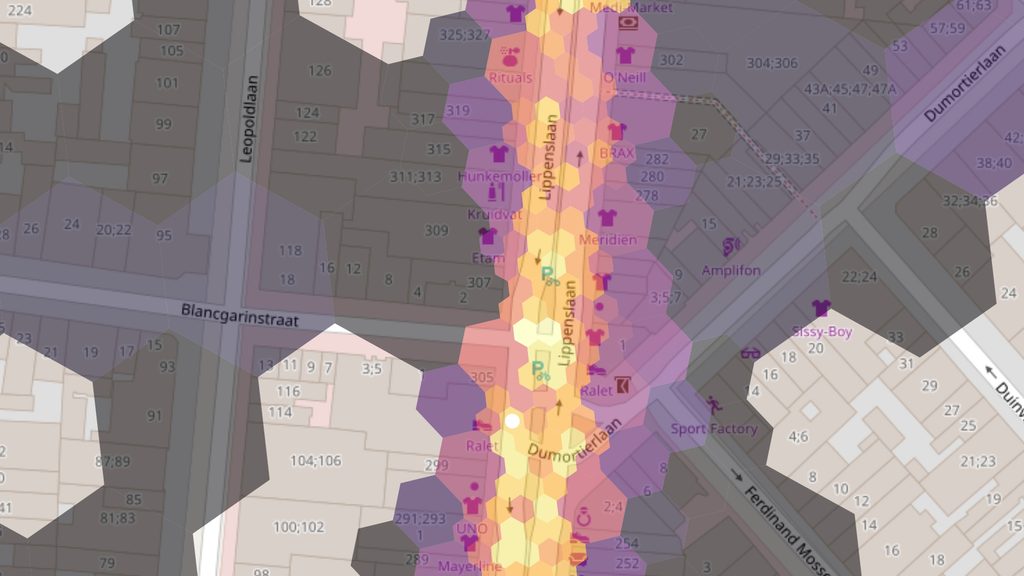
Lippenslaan is the main shopping boulevard of Knokke, the upmarket coastal resort that draws a largely leisure-driven crowd from across Belgium and beyond. The busiest stretch runs through the mid-section of the street, around the junction with Dumontierlaan, where pedestrians moving along the full length of the boulevard converge with those cutting across from the surrounding residential streets and beach district. The street is lined with a mix of fashion boutiques, lifestyle brands, and well-known retailers such as H&M, Hunkemöller, and Kruidvat, giving it a commercial density that keeps foot traffic steady throughout the day. With close to 5,000 tourist pedestrians counted passing through, Lippenslaan captures the relaxed but consistent rhythm of a Belgian seaside town that attracts a particularly affluent leisure crowd.
9. Zeedijk, Middelkerke: 4,290 Daily Tourists
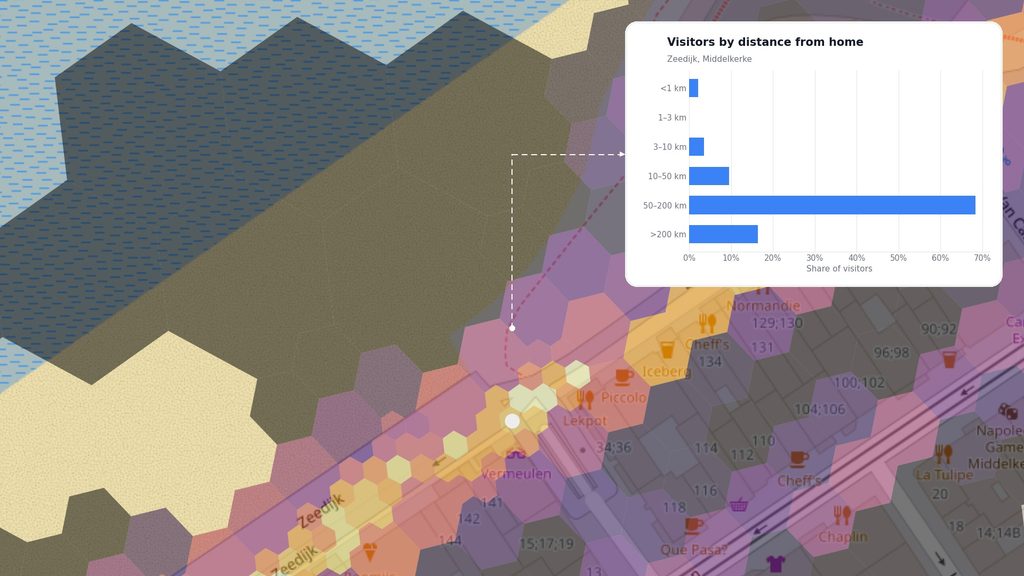
Zeedijk is Middelkerke’s seafront promenade, running parallel to the beach and drawing a steady flow of leisure-driven pedestrians past ice cream parlours, seafood snack bars, and small shops catering to a predominantly coastal crowd. The busiest point falls along the mid-section of the promenade, near the stretch around Vermeulen Optiek and the cluster of eateries including Piccolo and Lekpot, where foot traffic from the beach and the inland streets naturally converges. Middelkerke is one of the quieter resorts on the Belgian coast, but its long sandy beach and the presence of the Casinoplein give it a reliable seasonal draw that keeps the Zeedijk busy throughout the warmer months. With around 4,000 tourist pedestrians counted passing through, the promenade reflects the steady, unhurried rhythm of a Belgian seaside town that fills up considerably during school holidays and summer weekends.
10. Albert I Laan, Nieuwpoort: 3,880 Daily Tourists
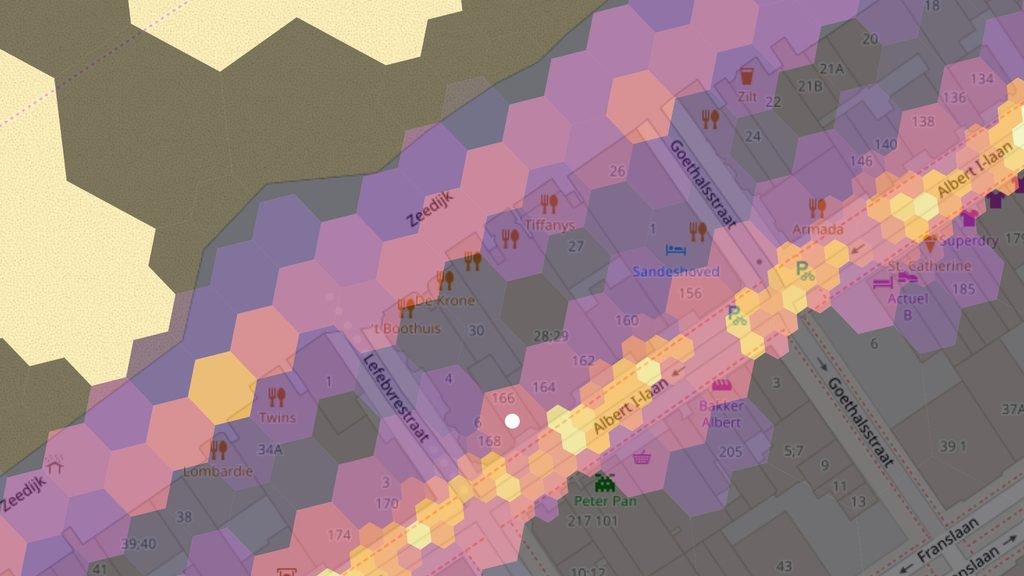
Albert I Laan is Nieuwpoort’s main coastal shopping boulevard, running parallel to the seafront and channelling pedestrians past a mix of fashion retailers, cafés, and lifestyle shops including ICI PARIS XL, Rituals, and Essentiel Antwerp. The busiest point falls along the mid-section of the street, near the junction with Lefebvrestraat, where foot traffic from the Zeedijk promenade and the inland town grid converges into a single corridor. Nieuwpoort-Bad draws a steady leisure crowd throughout the warmer months, with its long sandy beach and the nearby IJzermonding nature reserve giving it appeal beyond pure retail. With close to 4,000 tourist pedestrians counted passing through, Albert I Laan reflects the seasonal but reliable rhythm of a Belgian coastal resort that fills up considerably during summer and school holiday periods.
Top 10 Shopping Malls in Belgium by Daily Visitors
Brussels dominates the upper ranks, with the Royal Saint-Hubert Galleries, Carrefour City Centre, and Anspach Shopping all placing in the top five, confirming the capital as Belgium’s primary retail draw. Beyond Brussels, visitor demand is spread across a range of regional cities, from Liège, which places both Médiacité and Galeries Saint-Lambert in the top ten, to Wallonian centres such as Les Bastions in Tournai, Les Grands Prés in Mons, and Rive Gauche in Charleroi. For expansion teams, ranking malls by measured daily visitor demand rather than floor area or anchor tenants makes it possible to identify where genuine footfall exists and where gaps in the retail landscape may offer the strongest opportunity.
| City | Mall | Daily Visitors |
|---|---|---|
| Brussels | Galeries royales Saint-Hubert | 45,830 |
| Brussels | City 2 | 32,830 |
| Liège | Médiacité | 27,620 |
| Wijnegem | Wijnegem Shopping Center | 27,010 |
| Brussels | Anspach Shopping | 24,310 |
| Tournai | Centre Commercial Les Bastions | 21,880 |
| Mons | Les Grands Prés | 21,590 |
| Anderlecht | Westland Shopping | 21,300 |
| Liège | Galeries Saint-Lambert | 20,870 |
| Charleroi | Rive Gauche | 20,610 |
1. Galeries royales Saint-Hubert, Brussels: 45,830 Daily Visitors
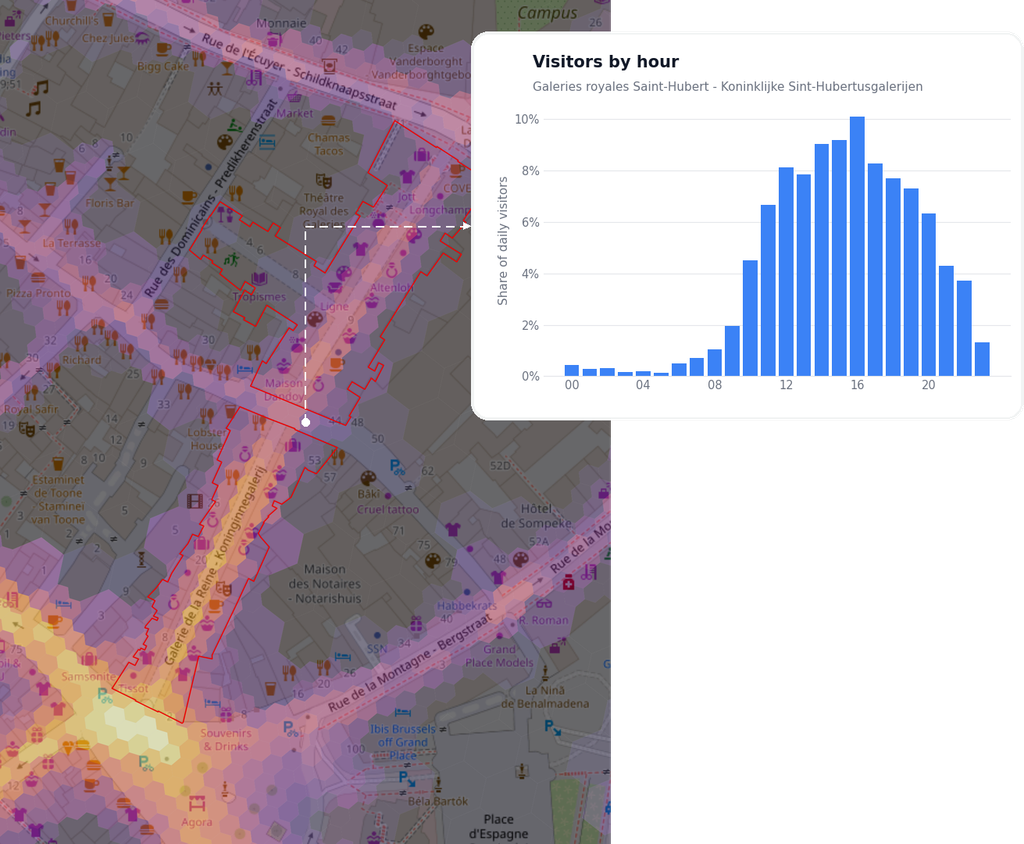
The Royal Saint-Hubert Galleries (Galeries Royales Saint-Hubert) is Belgium’s busiest shopping destination, drawing more than 45,000 visitors daily. This ensemble of three glazed arcades — the King’s Gallery, Queen’s Gallery, and Princes’ Gallery — was inaugurated in 1847 and predates famous counterparts such as the Galleria Vittorio Emanuele II in Milan. The busiest activity clusters around the King’s Gallery end, near the Grand-Place (Grote Markt), where chocolatiers, jewellers, and the historic Taverne du Passage draw steady crowds beneath the elegant cast-iron and glass roof.
2. City 2, Brussels: 32,830 Daily Visitors
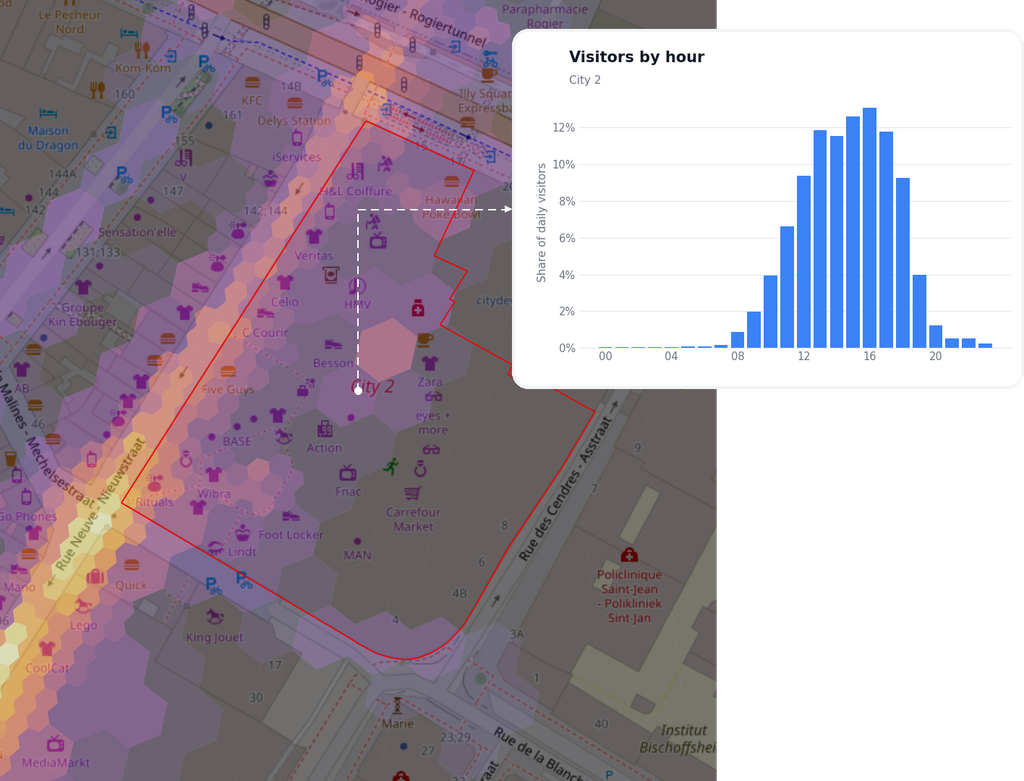
This Carrefour sits on Rue Neuve, Brussels’ busiest pedestrian shopping street, placing it among the most-visited retail destinations in Belgium. The location draws more than 32,000 visitors daily, ranking it second in the country. Its central position, close to Place de la Monnaie and well served by metro and tram connections, makes it a natural stop for both locals and tourists exploring the city centre.
3. Médiacité, Liège: 27,620 Daily Visitors
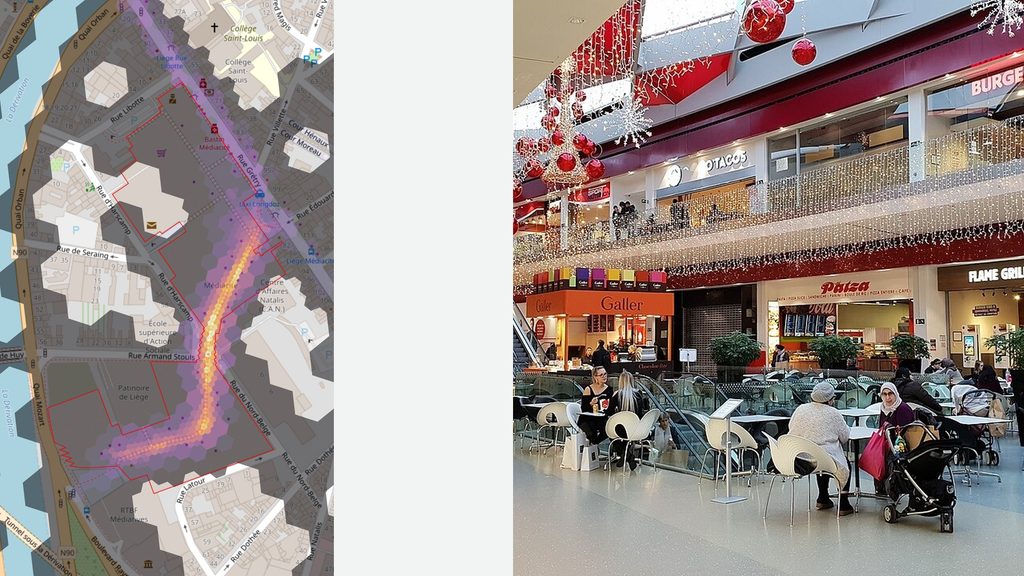
Médiacité is a large retail and entertainment centre in the Outremeuse district of Liège, ranking third among Belgium’s busiest shopping destinations. The busiest area of the centre draws a dense cluster of visitors towards its core retail zone. It attracts around 27,000 visitors daily, reflecting its strong draw in the eastern Belgian region.
4. Wijnegem Shopping Center, Wijnegem: 27,010 Daily Visitors
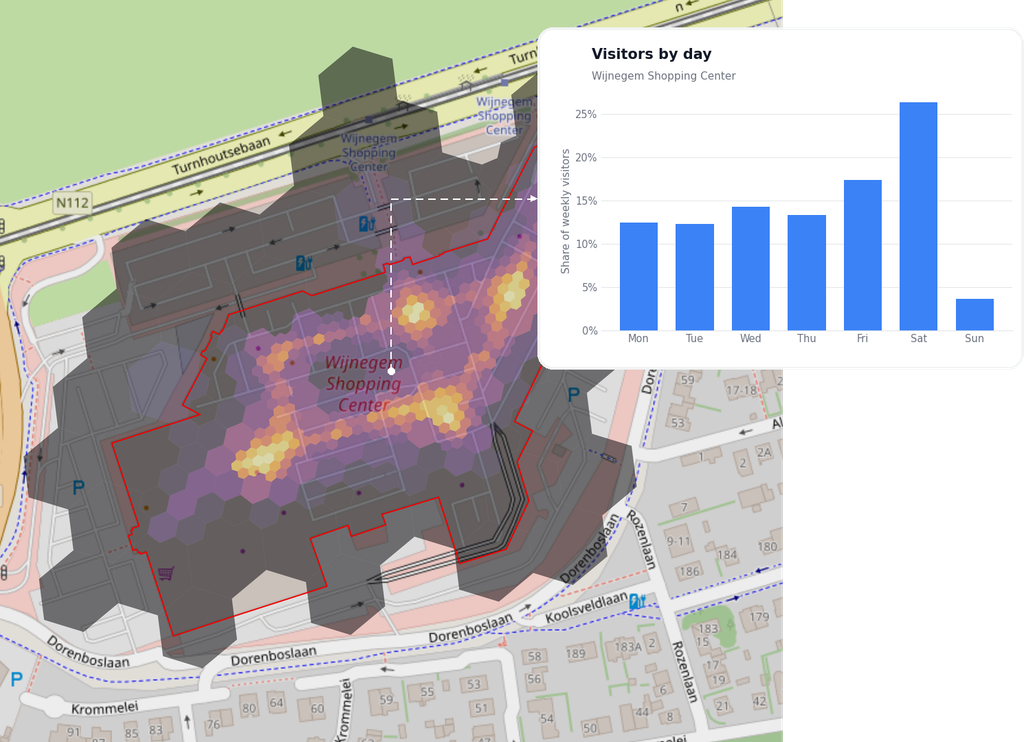
Wijnegem Shopping Centre, located just east of Antwerp along the Turnhoutsebaan, is one of Belgium’s busiest retail destinations, drawing more than 27,000 visitors daily. The heatmap shows the strongest concentration of activity near the MediaMarkt anchor, reflecting the centre’s pull as a major electronics and retail hub. It ranks fourth nationally, cementing its status as a key shopping destination in the Antwerp region.
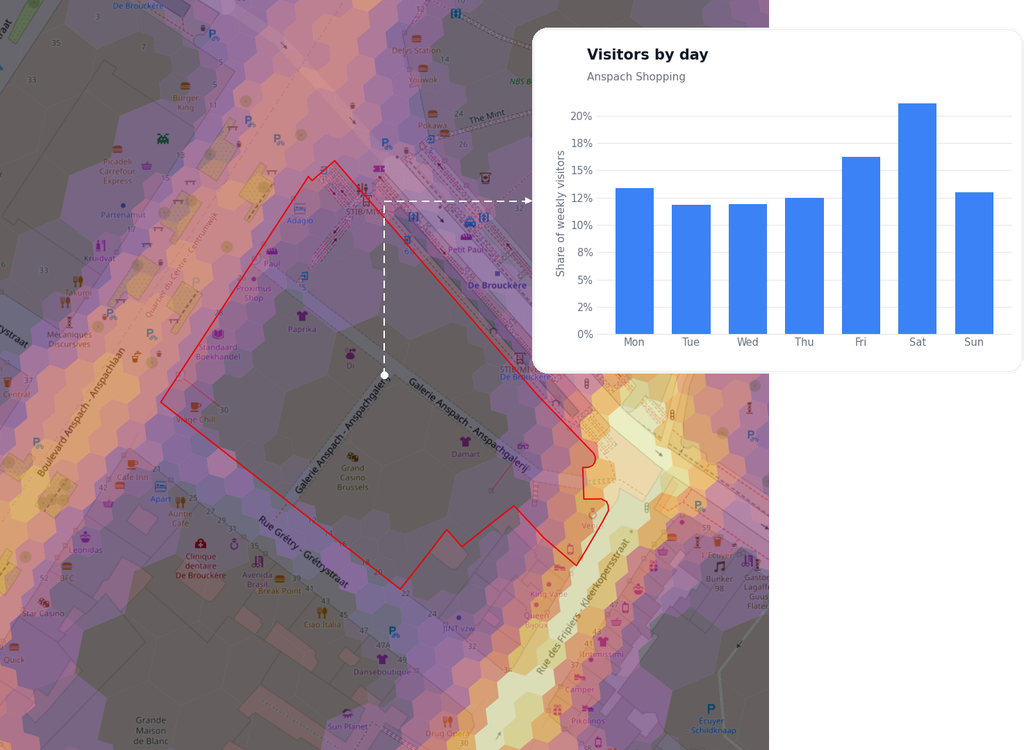
5. Anspach Shopping, Brussels (Bruxelles): 24,310 Daily Visitors
Anspach Shopping sits on Boulevard Anspach in the heart of Brussels, one of the city’s main commercial thoroughfares. The busiest activity clusters around the central entrance along the boulevard, reflecting its strong draw from passing street traffic. It ranks fifth nationally, attracting more than 24,000 visitors daily.
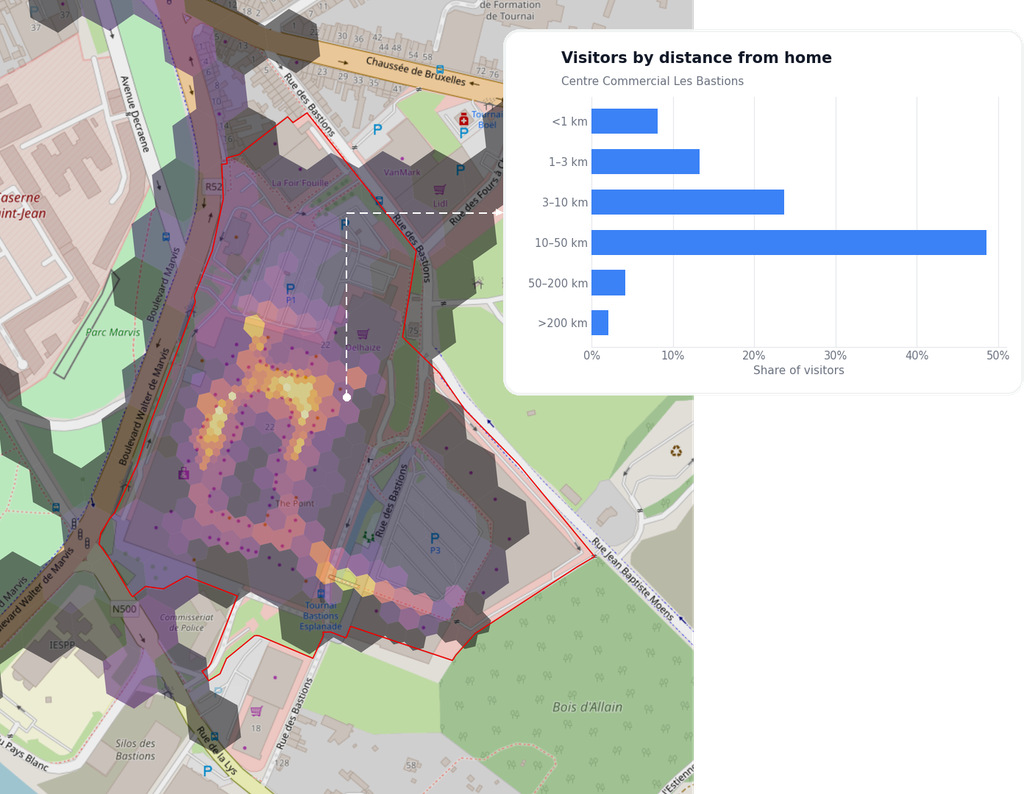
6. Centre Commercial Les Bastions, Tournai: 21,880 Daily Visitors
Centre Commercial Les Bastions is one of Belgium’s busier retail destinations, drawing close to 22,000 visitors daily and ranking sixth in the country. The centre sits along Boulevard Walter de Marvis in Tournai, a historic city in the Walloon region. Visitor activity is most concentrated around the main mall entrance and the surrounding retail frontage along the boulevard.
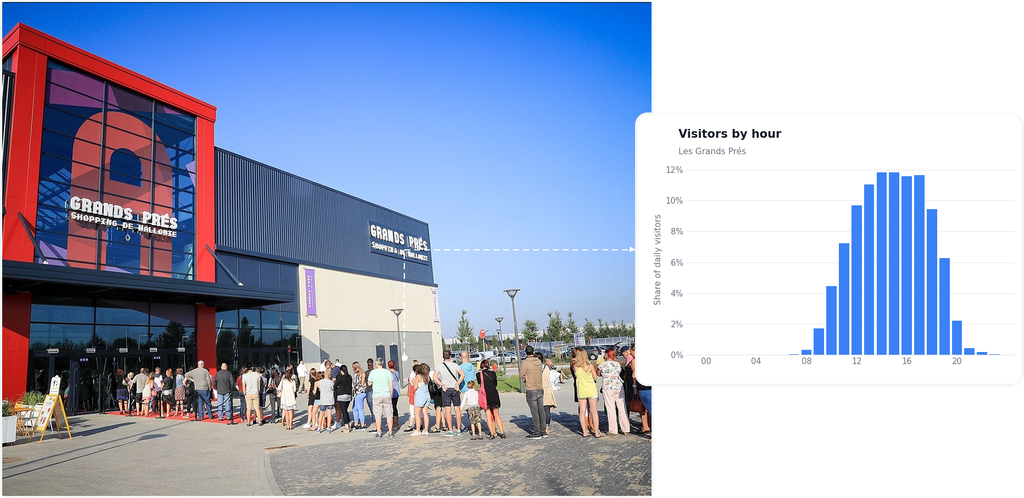
7. Les Grands Prés, Mons: 21,590 Daily Visitors
Les Grands Prés is a major regional shopping centre in Mons, drawing around 21,000 visitors daily. It ranks seventh in Belgium for visitor numbers, reflecting its strong draw across the wider Hainaut area. The busiest activity clusters around the central Place des Grands Prés, at the heart of the complex.
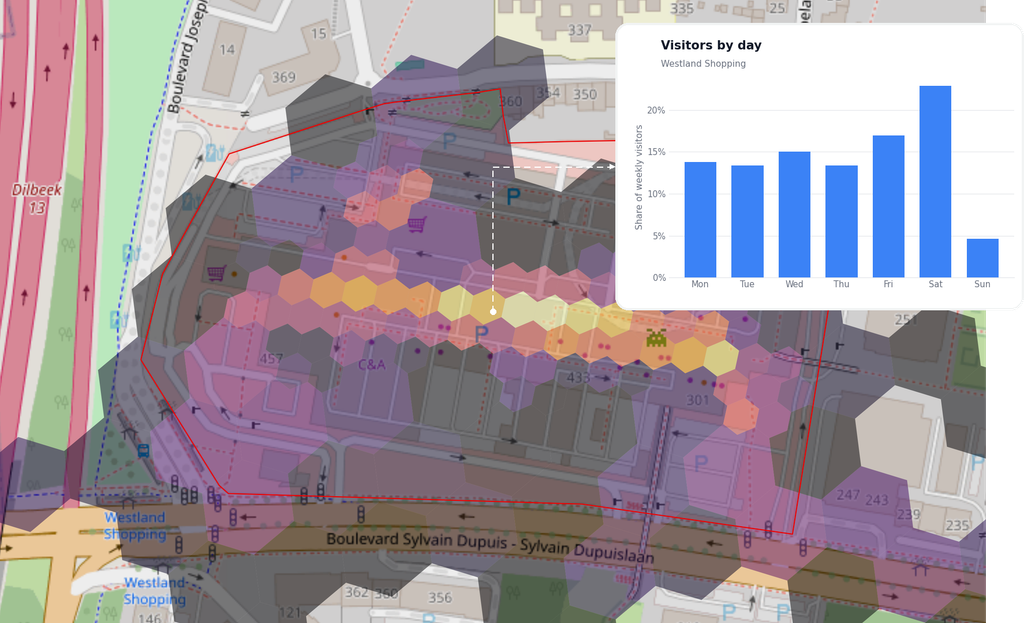
8. Westland Shopping, Anderlecht: 21,300 Daily Visitors
Westland Shopping is a large retail destination in Anderlecht, in the western outskirts of Brussels. It draws more than 21,000 visitors daily, making it one of the busiest shopping centres in Belgium. The heatmap shows the heaviest concentration of visitors around the main entrance along Dame Nature.
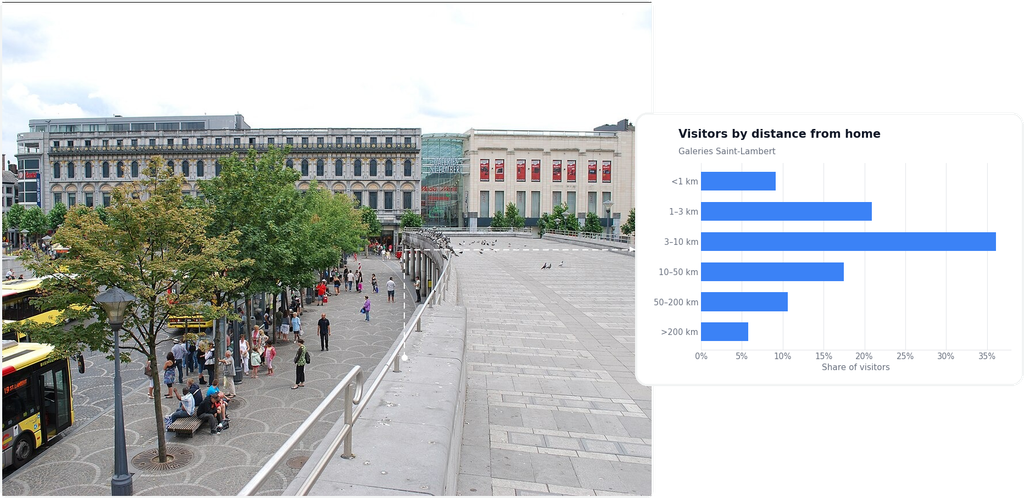
9. Galeries Saint-Lambert, Liège: 20,870 Daily Visitors
Galeries Saint-Lambert is a major city-centre shopping destination in Liège, drawing around 20,000 visitors daily. The busiest area clusters tightly around the main gallery spine, reflecting its role as a key retail hub in the heart of the city. It ranks ninth among the most-visited shopping centres in Belgium.
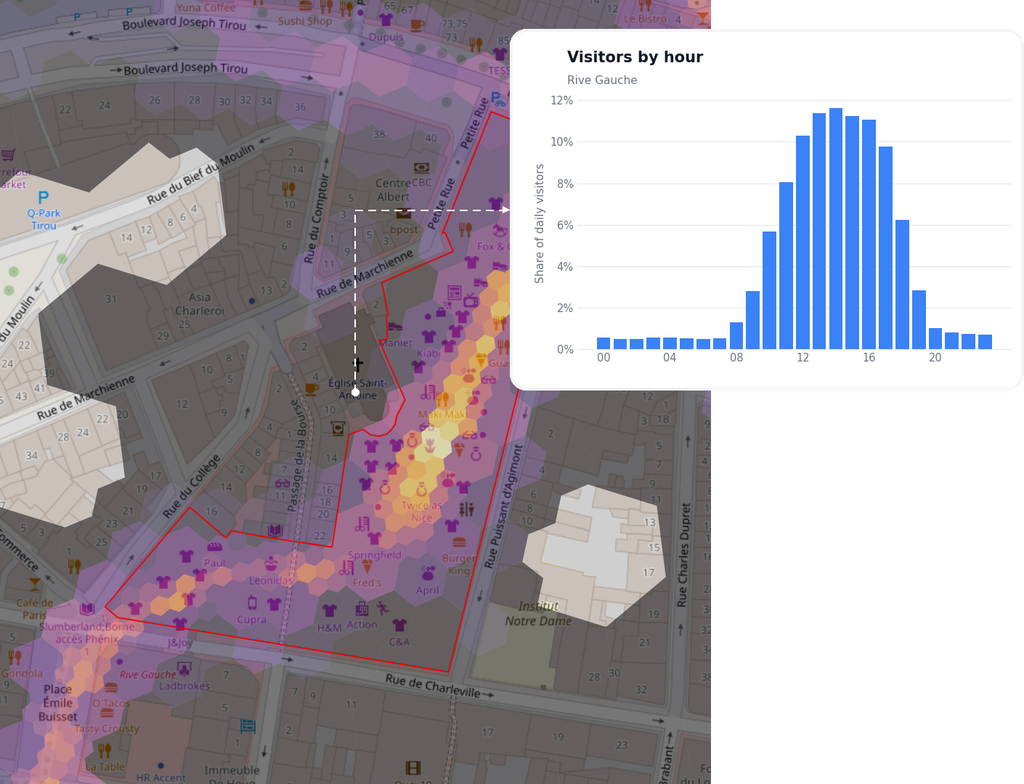
10. Rive Gauche, Charleroi: 20,610 Daily Visitors
Rive Gauche is a major city-centre shopping centre located on Place Verte in Charleroi, drawing more than 20,000 visitors daily. It ranks tenth among shopping centres in Belgium, reflecting its strong pull as a retail destination in the heart of Wallonia. The busiest activity clusters around the main entrance area, making it a prominent fixture in Charleroi’s commercial landscape.
Terminology note: In this article, footfall refers to estimated pedestrian activity in a specific street segment. In Dutch, commonly used terms include voetgangersstroom and voetgangersverkeer. Visitors refers to people who spend at least 5 minutes in a specific place. In Dutch, commonly used terms include bezoekers, aantal bezoekers, and bezoekersaantallen.
Use Footfall Data for Smarter Retail Site Selection
Footfall data is a powerful starting point for retail expansion. It shows where people move, which streets attract the highest pedestrian flows, and how shopping centres compare by daily visitors. But the busiest location is not always the best location for every concept. A strong site decision also depends on catchments, accessibility, local demographics, competitors and complementary POIs, and visitor behaviour.
With TargomoLOOP, expansion teams can view footfall data in context and compare locations more confidently. For teams that want to integrate location intelligence into their own systems, TargomoAPI provides access to our geospatial data and analysis capabilities.
Whether you are opening a first store in Belgium or optimising an existing network, combining retail expansion strategy with granular Belgium footfall data reduces guesswork. Our foot traffic and tourist datasets help teams compare streets, districts, and malls, so every site decision is grounded in measured demand.
Ready to explore better locations with Targomo’s Footfall Data?
Book a demo to see how TargomoLOOP can support retail site selection, market entry and network expansion.
You May Also Be Interested in