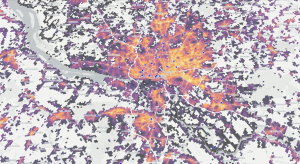
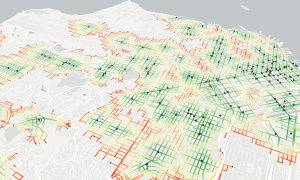







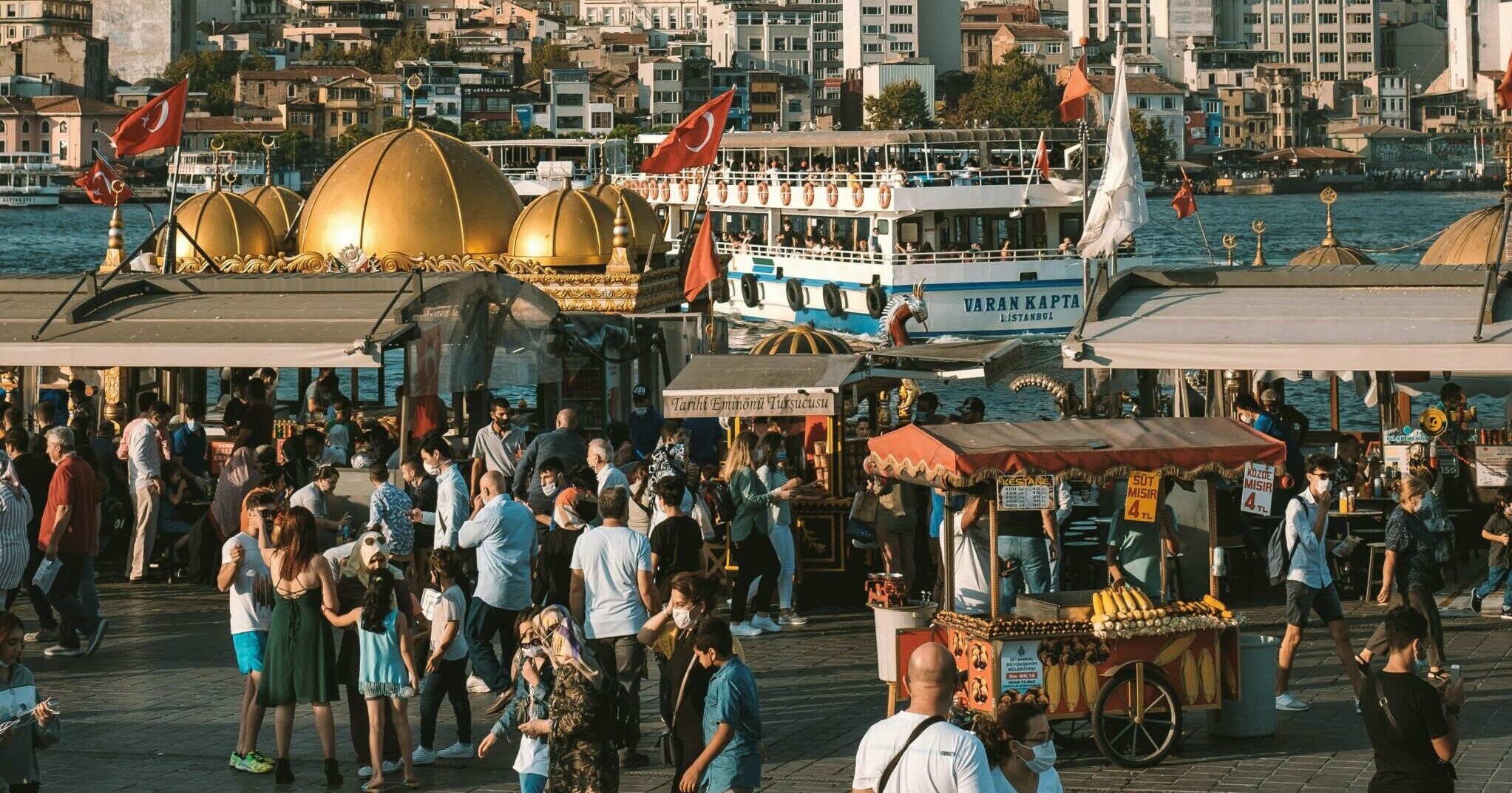
Choosing the right location is one of the most important decisions in retail expansion, yet the busiest places are not always the most obvious. From Istanbul’s dense commercial districts to Aegean resort towns and major regional centres, pedestrian movement in Türkiye takes many different forms. Targomo’s 2025 foot traffic data reveals where these flows are most concentrated, giving expansion teams a more granular basis for retail site selection.
The analysis covers three top 10 rankings: the busiest street-level points, the locations with the strongest tourist footfall, and the shopping centres attracting the most daily visitors. Street and tourist figures refer to the busiest measured point within roughly a 20-metre radius, such as a street segment, square or junction. Shopping-centre figures instead represent total average daily visitors across the entire centre.
Terminology note: In this article, footfall refers to estimated pedestrian activity in a specific street segment. In Turkish, commonly used terms include yaya trafiği and yaya yoğunluğu. Visitors refers to people who spend at least 5 minutes in a specific place. In Turkish, commonly used terms include ziyaretçiler, ziyaretçi sayısı, and ziyaretçi akışı.
Jump to:
Top 10 Footfall Spots in Türkiye by Daily Pedestrian Traffic
Istanbul dominates the ranking, accounting for six of the ten entries and spanning both the European and Asian sides of the city, from İstiklal Avenue and Bakırköy to Kadıköy and Beşiktaş. Beyond Istanbul, İzmir contributes two entries through Kemeraltı and Karşıyaka, while Ankara and Bursa each claim one place, confirming that high-density pedestrian activity extends into major provincial centres. For expansion teams, this ranking identifies the specific streets and junctions — such as the Fahri Korutürk and Fişekhane Caddesi crossroads in Bakırköy or the Karanfil Sokağı and Yüksel Caddesi junction in Kızılay — where daily foot traffic is actually concentrated, giving a precise starting point for site selection rather than relying on district-level assumptions alone.
| City | Place | Daily Footfall |
|---|---|---|
| Istanbul | İstiklal Avenue | 92,390 |
| Istanbul | Muvakkithane Caddesi, Kadıköy | 73,720 |
| Istanbul | Fahri Korutürk Caddesi, Bakırköy | 70,720 |
| Istanbul | Çiçek Pazarı Caddesi, Tahtakale | 70,170 |
| İzmir | Anafartalar Caddesi, Kemeraltı | 58,550 |
| İzmir | Kemalpaşa Caddesi, Karşıyaka | 56,880 |
| Istanbul | Hagia Sophia Square, Sultanahmet | 54,200 |
| Ankara | Karanfil Sokağı, Kızılay | 54,000 |
| Bursa | Cumhuriyet Caddesi, Osmangazi | 53,280 |
| Istanbul | Barbaros Bulvar, Beşiktaş | 44,770 |
1. İstiklal Avenue, Istanbul: 92,390 Daily Footfall
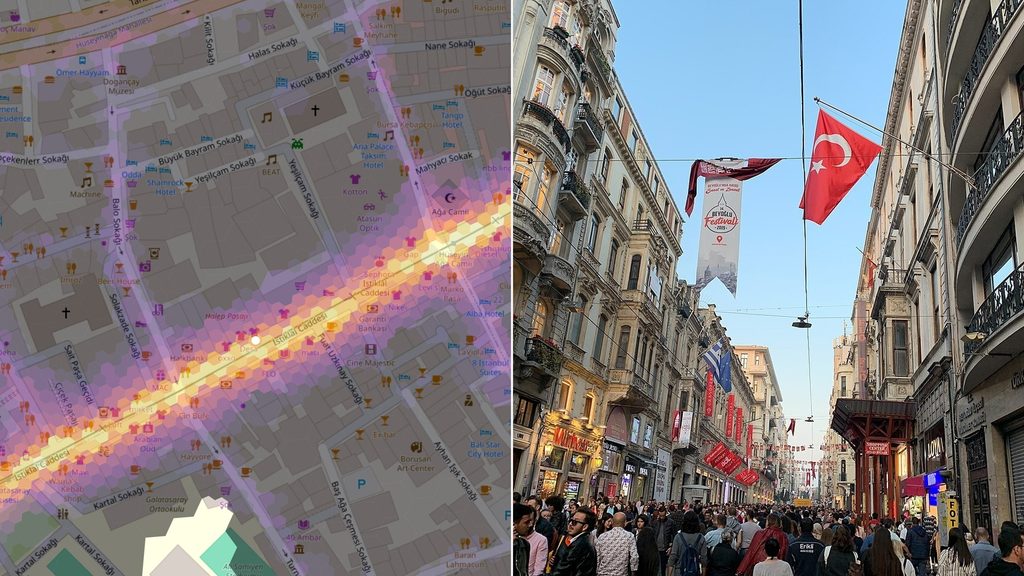
İstiklal Avenue is Istanbul’s most heavily trafficked pedestrian street, running through the heart of the Beyoğlu district and drawing more than 92,000 people in our data. The peak footfall concentrates around the stretch near Halep Pasajı and the junction with Yeşilçam Sokağı, where global retail names such as Gap, Sephora, Nike, and Levi’s sit alongside local shops and historic arcades. The avenue connects Taksim Square to Galatasaray Lisesi and beyond, giving it both a commercial and cultural pull that keeps pedestrian numbers high throughout the day. Its mix of retail, dining, entertainment venues, and easy access to side streets like Balo Sokağı and Büyük Bayram Sokağı makes it a natural magnet for foot traffic across all hours.
2. Muvakkithane Caddesi, Kadıköy, Istanbul: 73,720 Daily Footfall
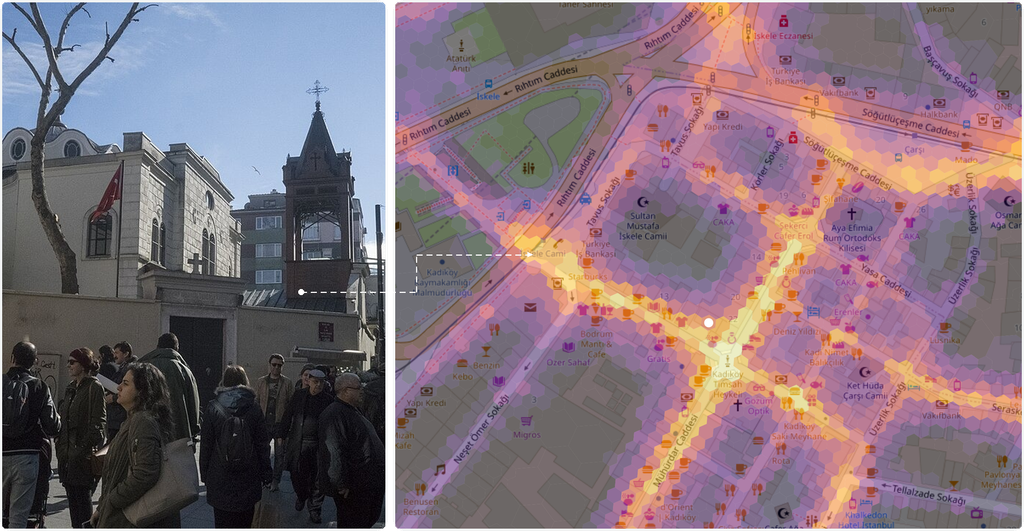
Kadıköy is one of Istanbul’s most commercially active districts on the Asian side, and the stretch of Muvakkithane Caddesi around the Kadıköy Timsah Heykel (Crocodile Statue) junction draws more than 73,000 people in our data. The busiest point sits where Muvakkithane Caddesi meets the pedestrian arteries fanning out towards the Kadıköy market quarter, with shops, cafés, and street food stalls generating steady foot traffic throughout the day. The area benefits from its proximity to Kadıköy ferry terminal on Rihtım Caddesi, which funnels commuters and day-trippers directly into the heart of the neighbourhood. Söğütlüçeşme Caddesi and Neşet Ömer Sokağı further extend the commercial catchment, making this junction a key node in the district’s dense pedestrian network.
3. Fahri Korutürk Caddesi, Bakırköy, Istanbul: 70,720 Daily Footfall
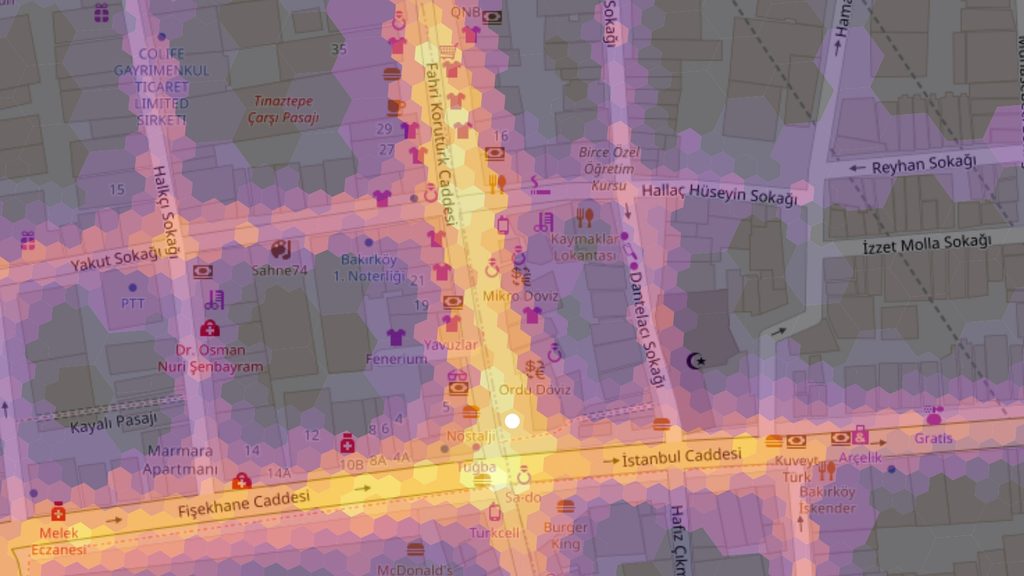
Fahri Korutürk Caddesi is the main pedestrian spine of Bakırköy, one of Istanbul’s most commercially active districts on the European side, drawing more than 70,000 people in our data. The peak footfall falls at the crossroads where Fahri Korutürk Caddesi meets Fişekhane Caddesi and İstanbul Caddesi, forming a busy retail intersection lined with high-street names, exchange offices, and food chains including McDonald’s and Burger King. Bakırköy Yeraltı Çarşısı, the district’s underground shopping bazaar, sits directly beneath this junction and adds a further draw that keeps pedestrian numbers consistently high. The surrounding streets — including Ebuziya Caddesi to the south and Dantelacı Sokağı to the east — extend the commercial catchment and reinforce Bakırköy’s role as a key retail destination on the city’s European shore.
4. Çiçek Pazarı Caddesi, Tahtakale, Istanbul (İstanbul): 70,170 Daily Footfall
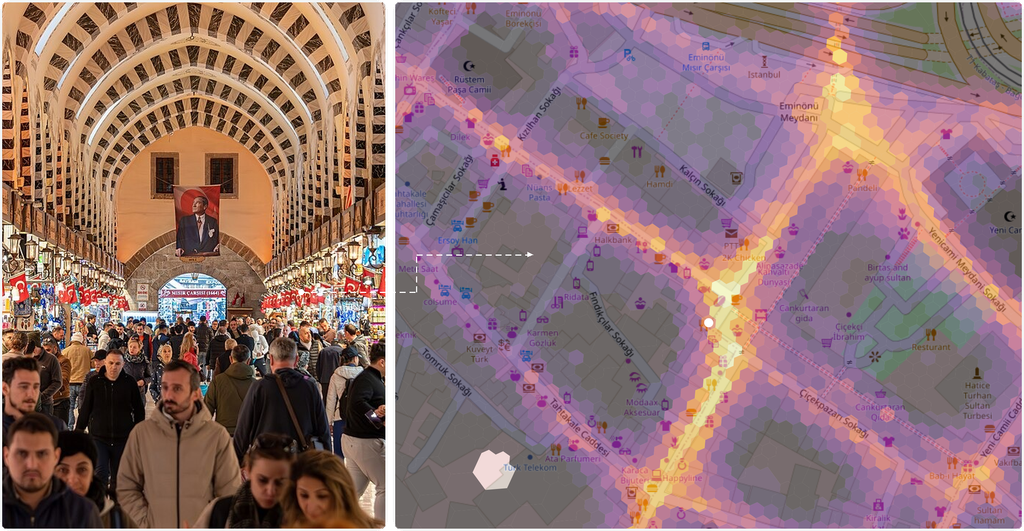
Çiçek Pazarı Caddesi cuts through the heart of Tahtakale, one of Istanbul’s oldest and most densely traded commercial quarters in the Fatih district, drawing more than 70,000 people in our data. The busiest stretch sits where the street converges with Fındıkçılar Sokağı and the lanes feeding into the broader Tahtakale wholesale market, creating a tight corridor of jewellery sellers, spice dealers, and household goods traders. The area sits just a short walk from Eminönü Square (Eminönü Meydanı) and the Egyptian Bazaar (Mısır Çarşısı), meaning foot traffic is fed by both local shoppers and day-trippers crossing the Golden Horn. The convergence of several narrow pedestrian lanes at this point makes it one of the most concentrated commercial nodes in the historic peninsula.
5. Anafartalar Caddesi, Kemeraltı, İzmir: 58,550 Daily Footfall
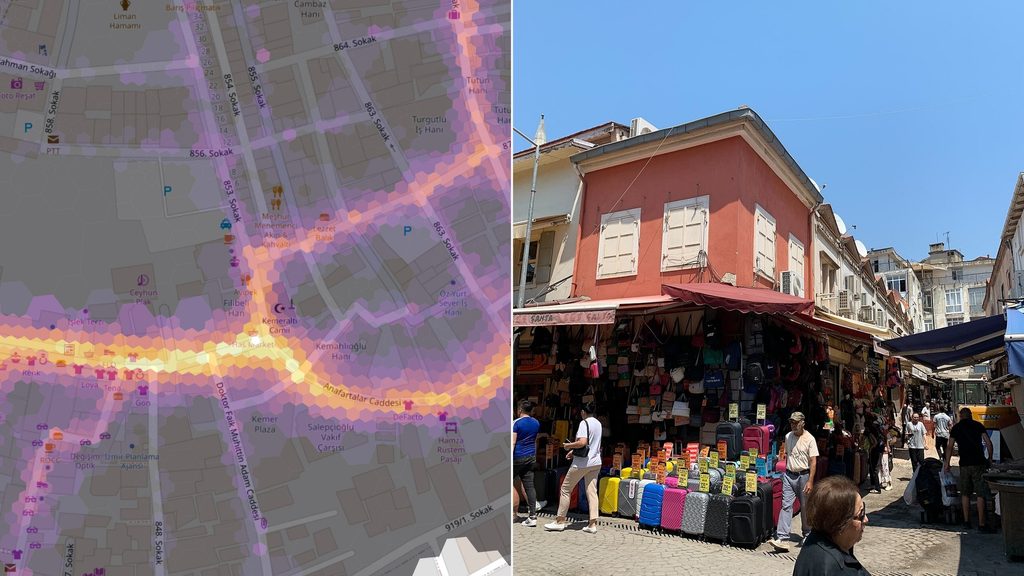
Anafartalar Caddesi is the main commercial artery running through Kemeraltı, İzmir’s historic bazaar quarter in the Konak district, drawing more than 58,000 people in our data. The busiest stretch sits near the junction with Doktor Falk Mühürtin Adam Caddesi, close to Kemeraltı Camii and the Flaş Market, where the street is lined with clothing retailers, opticians, and food stalls. The surrounding passages — including Salepçioğlu Vakıf Çarşısı and Kemahlıoğlu Hanı — draw additional foot traffic into the wider bazaar network. Proximity to İzmir Government House (İzmir Hükümet Konağı) and the waterfront at Konak Square (Konak Meydanı) ensures a steady flow of both local shoppers and commuters throughout the day.
6. Kemalpaşa Caddesi, Karşıyaka, İzmir: 56,880 Daily Footfall
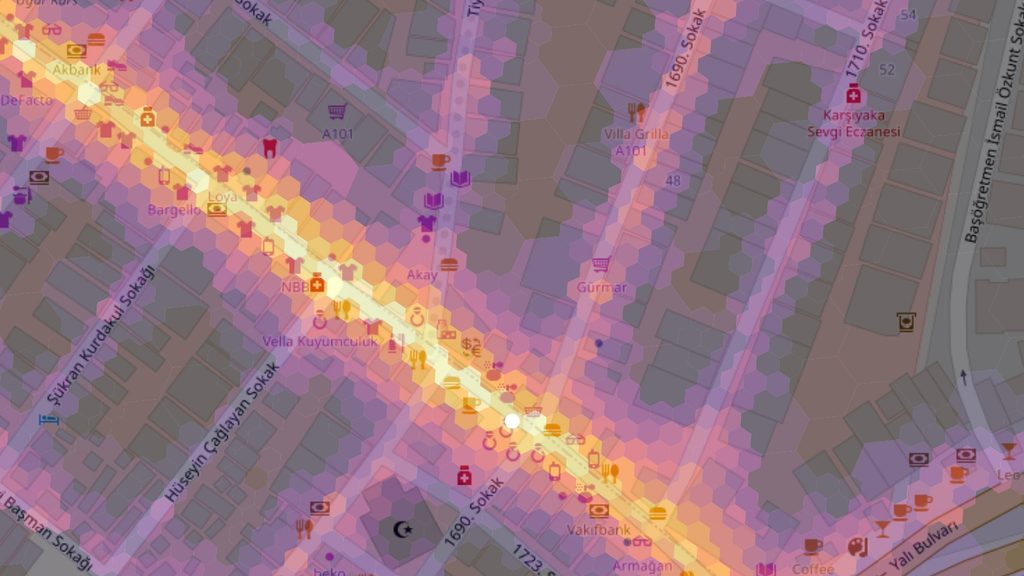
Kemalpaşa Caddesi is the main pedestrian shopping street of Karşıyaka, a popular district on the northern shore of İzmir Bay, drawing more than 56,000 people in our data. The busiest stretch runs around the junction with Hüseyin Çağlayan Sokağı, where clothing retailers, jewellers such as Vella Kuyumculuk, and everyday shops line both sides of the street. Karşıyaka İskele, the district’s ferry terminal on Yalı Bulvarı, sits just a short walk to the south and channels a steady stream of commuters directly into the commercial corridor. The street’s role as Karşıyaka’s retail backbone, combined with strong ferry and local transport connections, keeps foot traffic high throughout the day.
7. Hagia Sophia Square, Sultanahmet, Istanbul: 54,200 Daily Footfall
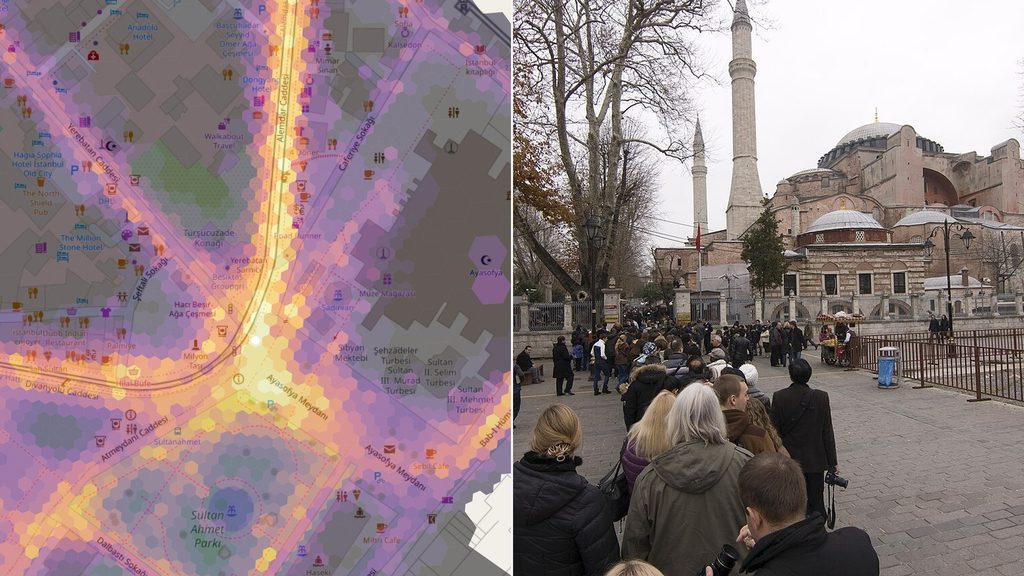
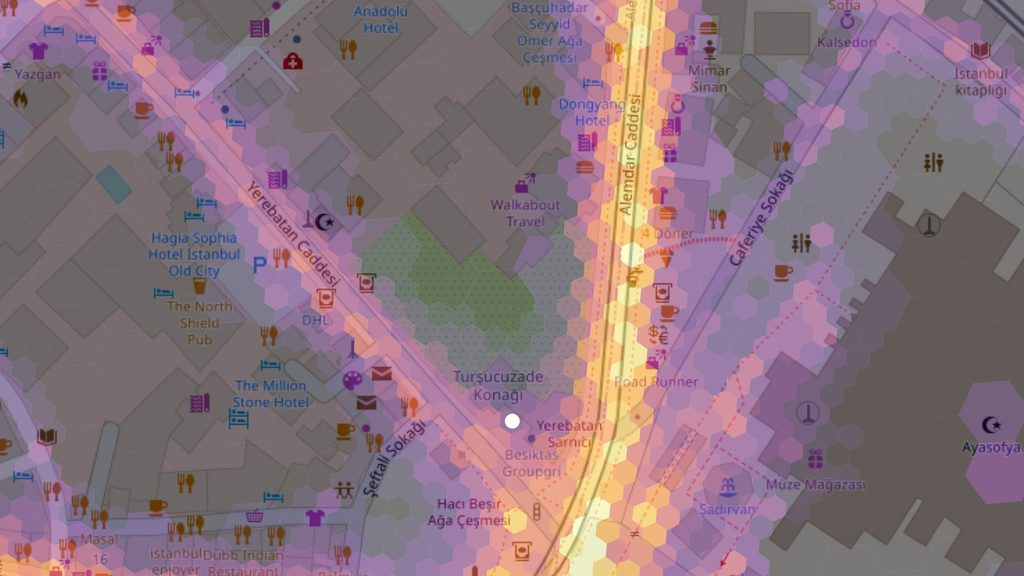
Hagia Sophia Square (Ayasofya Meydanı) sits at the heart of the Sultanahmet district, where Alemdar Caddesi and Atmeydanı Caddesi converge just in front of Hagia Sophia (Ayasofya) itself, drawing more than 54,000 people in our data. The peak concentration falls precisely at this junction, where pedestrian flows from Divanyolu Caddesi to the west and the Yerebatan Cistern (Yerebatan Sarnıcı) to the north funnel together before spreading out across the square. The square is flanked by the Blue Mosque (Sultanahmet Camii) to the south and Sultan Ahmet Parkı in between, making it one of the most historically dense stretches of the old city. Its position as the natural crossroads between Istanbul’s most visited monuments ensures a continuous stream of foot traffic from morning to evening.
8. Karanfil Sokağı, Kızılay, Ankara: 54,000 Daily Footfall
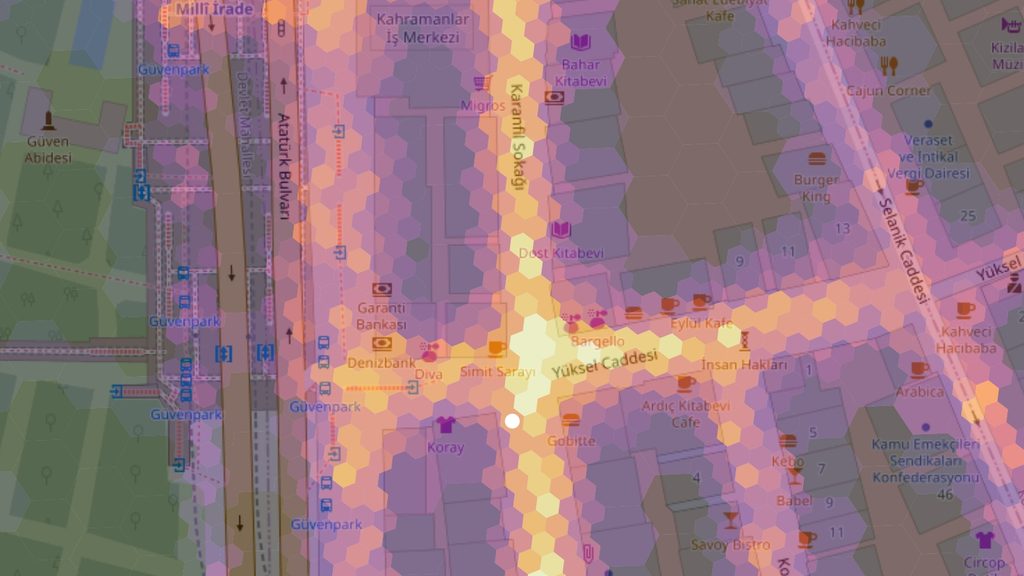
Karanfil Sokağı is one of Kızılay’s busiest pedestrian corridors in central Ankara, drawing more than 54,000 people in our data. The peak footfall falls at the crossroads where Karanfil Sokağı meets Yüksel Caddesi, a stretch lined with cafés, bookshops, and everyday retail including a Migros supermarket and the stationery chain Barçello. Atatürk Bulvarı, Ankara’s main north–south artery, runs just to the west and channels a continuous flow of commuters and shoppers into the surrounding street grid. The area’s dense mix of offices, eateries, and public transport stops along Atatürk Bulvarı makes this junction a natural pressure point for foot traffic throughout the working day.
9. Cumhuriyet Caddesi, Osmangazi, Bursa: 53,280 Daily Footfall
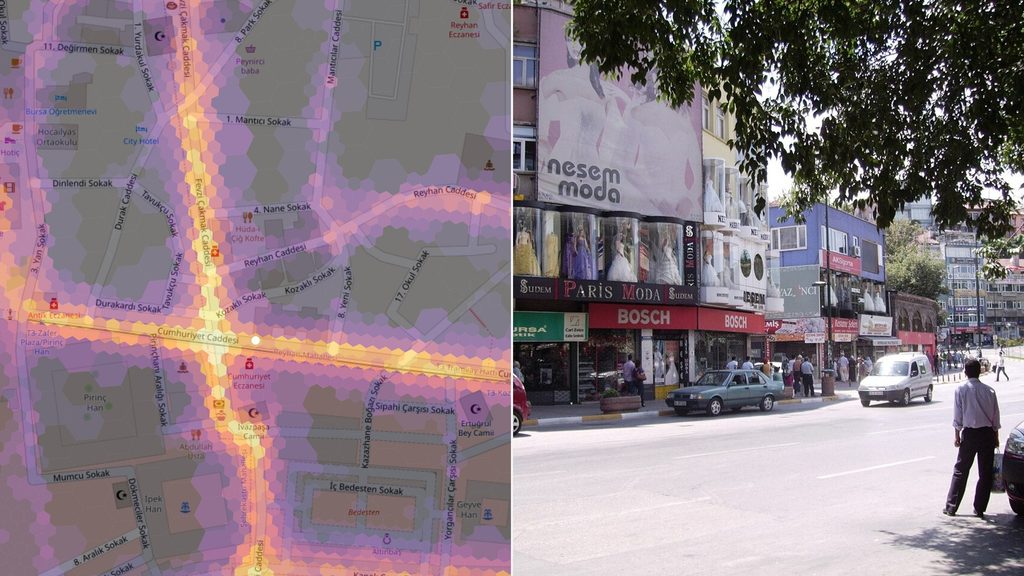
Cumhuriyet Caddesi is Bursa’s main east–west commercial artery in the Osmangazi district, drawing more than 53,000 people in our data. The peak footfall falls precisely at the crossroads where Cumhuriyet Caddesi meets Fevzi Çakmak Caddesi, a junction that sits at the edge of Bursa’s historic covered bazaar quarter and connects the modern retail strip to the Bedesten and Kapalı Çarşı to the south. The T3 tram line runs along Cumhuriyet Caddesi itself, with the Kozahan stop nearby channelling a steady stream of commuters directly into this intersection. The surrounding streets — including Tavukçu Sokağı to the west and Reyhan Caddesi to the east — extend the commercial catchment further, reinforcing this junction’s role as a key pedestrian node in central Bursa.
10. Barbaros Bulvarı, Beşiktaş, Istanbul: 44,770 Daily Footfall
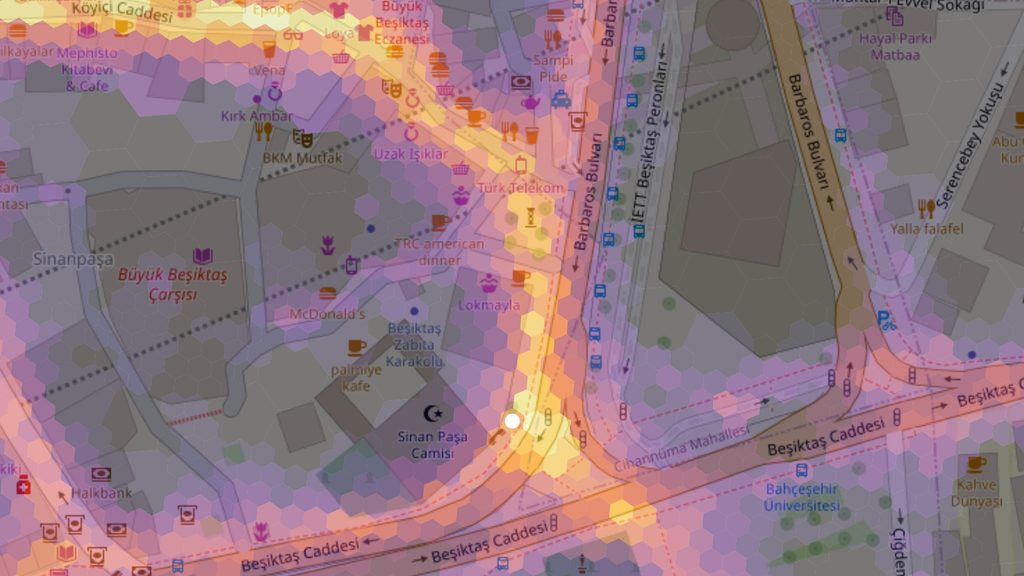
Barbaros Bulvarı is the main north–south artery cutting through Beşiktaş, one of Istanbul’s most active districts on the European shore of the Bosphorus, drawing more than 44,000 people in our data. The peak footfall falls at the junction where Barbaros Bulvarı meets Beşiktaş Caddesi, just beside Sinan Paşa Camii, where pedestrian flows from Büyük Beşiktaş Çarşısı to the west and Beşiktaş Meydanı to the south converge in a tight knot. The area benefits from dense bus connections along Barbaros Bulvarı and easy access to Beşiktaş ferry terminal (Beşiktaş Motor İskelesi) a short walk to the south, funnelling commuters directly into this corridor. The Naval Museum (Deniz Müzesi) and the surrounding retail and food offer along Köyiçi Caddesi further extend the catchment, keeping footfall consistently high throughout the day.
Top 10 Tourist Hotspots by Foot Traffic in Türkiye
These locations rank by tourist footfall — pedestrians who live more than 50 kilometres away. Only places where tourists account for at least 70% of total footfall are included, to surface destinations with a genuinely tourist-driven pedestrian profile.
Istanbul’s Sultanahmet corridor and the lanes of Alaçatı and Mardin’s 1. Cadde confirm that tourist footfall in Türkiye clusters most sharply around historic monument districts and characterful old-town streets rather than conventional shopping areas. The data also highlight the pull of waterfront and island destinations, with Avşa Island, Cunda Island, Kaş, and Mersin’s Cumhuriyet Bulvarı all generating footfall where almost every pedestrian has made a deliberate journey to be there. For expansion teams, the ranking identifies the specific streets and junctions — from Yerebatan Caddesi in Istanbul to Kemalpaşa Caddesi in Alaçatı and Side Caddesi in Antalya — where tourist demand is most concentrated, giving a precise starting point for site selection rather than relying on city-level assumptions alone.
| City | Place | Daily Footfall | Daily Tourist Footfall |
|---|---|---|---|
| Istanbul | Yerebatan Caddesi, Sultanahmet | 25,290 | 18,040 |
| İzmir | Kemalpaşa Caddesi, Alaçatı | 15,700 | 13,410 |
| Antalya | Side Caddesi, Side | 17,630 | 13,280 |
| Şanlıurfa | Balıklıgöl Caddesi, Şanlıurfa | 15,610 | 11,410 |
| Balıkesir | Ömer Kaptan Caddesi, Avşa Island | 11,660 | 10,560 |
| Mersin | Cumhuriyet Bulvarı, Akdeniz, Mersin | 11,450 | 9,720 |
| Mardin | 1. Cadde (First Street), Mardin | 12,430 | 9,520 |
| Antalya | Atatürk Bulvarı, Kaş | 11,090 | 8,830 |
| Istanbul | Çadırcılar Caddesi, Beyazıt | 11,720 | 8,300 |
| Balıkesir | Çarşı Caddesi, Cunda Island | 10,840 | 8,180 |
1. Yerebatan Caddesi, Sultanahmet, Istanbul: 18,040 Daily Tourists
The peak footfall on Yerebatan Caddesi falls at the point where the street curves towards the entrance of the Yerebatan Cistern (Yerebatan Sarnıcı), with Hagia Sophia (Ayasofya) just a short walk to the east and Divanyolu Caddesi feeding pedestrian flows in from the west. This stretch of Sultanahmet sits at the crossroads of two of Istanbul’s most historically significant monuments, making it a natural pinch point for anyone exploring the old city. The Milyon Taşı — the ancient milestone from which Roman road distances were once measured — stands nearby, adding yet another layer of historical significance to what is already a densely layered quarter. Already featured in our overall ranking, Hagia Sophia Square draws enormous footfall from all directions, and this data confirms that the corridor along Yerebatan Caddesi leading to the Cistern entrance is where tourist foot traffic peaks most sharply.
2. Kemalpaşa Caddesi, Alaçatı, İzmir: 13,410 Daily Tourists
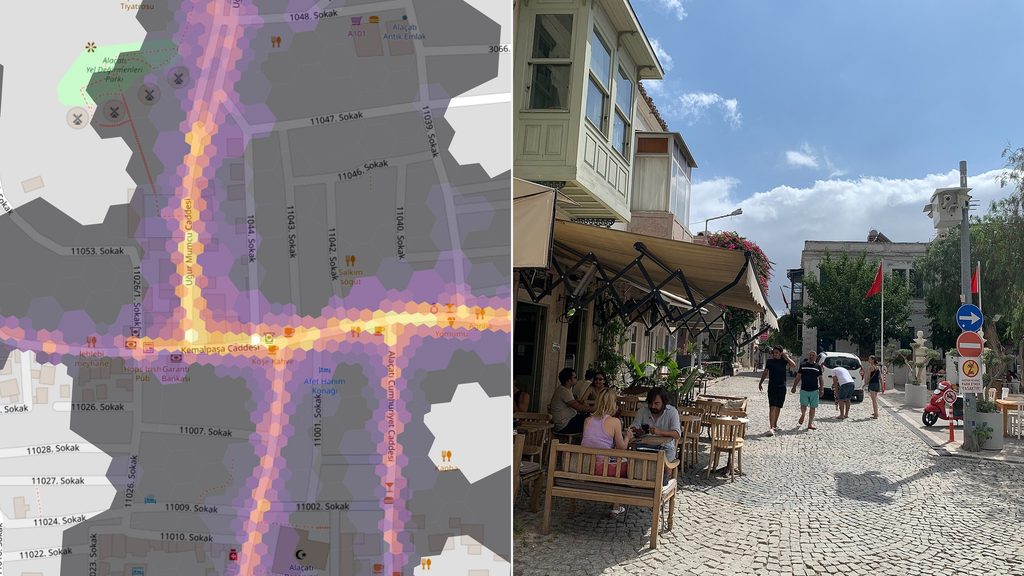
Alaçatı is one of the Aegean coast’s most sought-after destinations, and the peak footfall falls right at the heart of Kemalpaşa Caddesi where it crosses 1044. Sokak and Uğur Mumcu Caddesi — a stretch lined with cafés, boutiques, and meyhanes that defines the town’s character. The surrounding streets, including Alaçatı Cumhuriyet Caddesi to the east, extend the pedestrian catchment through a dense grid of stone-paved lanes. With more than 13,000 of its roughly 15,000 daily pedestrians counted as touristic, Alaçatı draws a crowd that is almost entirely here for the town itself rather than passing through.
3. Side Caddesi, Side, Antalya: 13,280 Daily Tourists
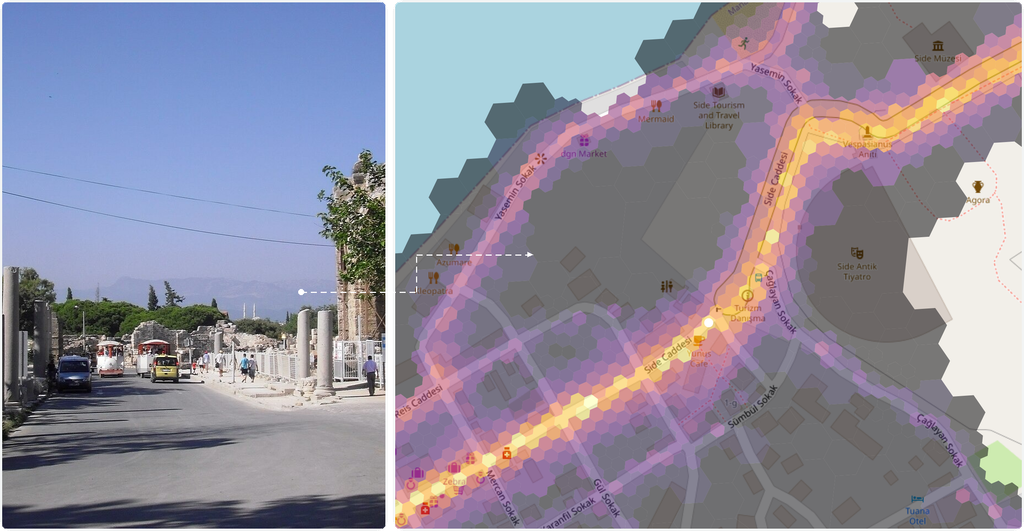
Side Caddesi is the main pedestrian artery running through the ancient town of Side, where the street narrows into a dense corridor of souvenir shops, cafés, and restaurants built directly alongside Roman-era remains. The peak concentration of footfall falls at the junction where Side Caddesi meets Çağlayan Sokak, close to the tourism information office and just steps from the Vespasianus Anıtı monument. Side’s ancient theatre, the Agora, and the Side Museum sit within easy walking distance, drawing more than 17,000 people daily, with around 13,000 of those counted as touristic. The town’s compact peninsula layout means almost every pedestrian on Side Caddesi is here for the place itself rather than passing through.
4. Balıklıgöl Caddesi, Şanlıurfa, Şanlıurfa: 11,410 Daily Tourists
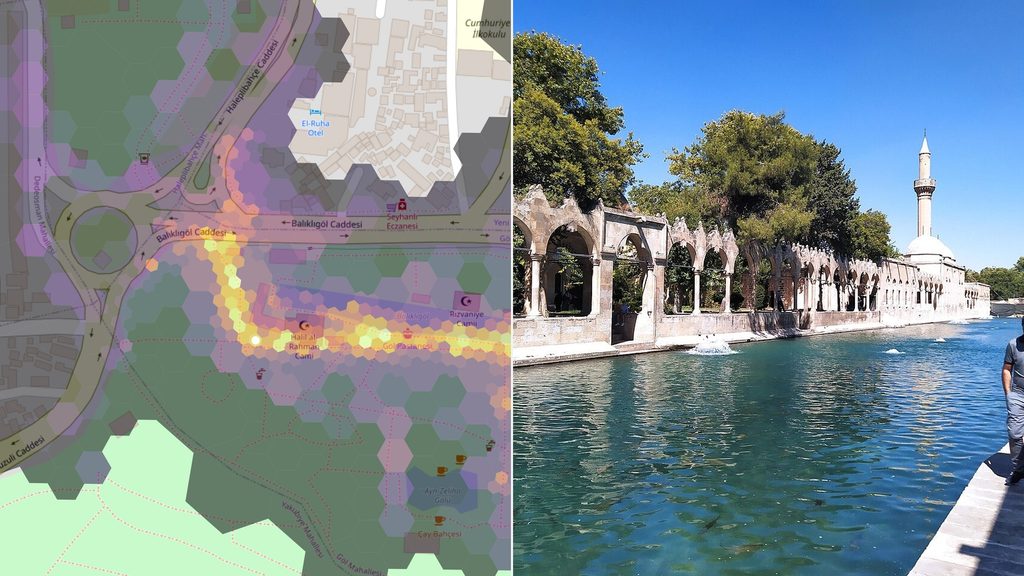
Balıklıgöl Caddesi runs alongside the sacred Pool of Abraham (Balıklıgöl), one of the most revered sites in southeastern Turkey, where the footfall peak clusters tightly between Halil al-Rahman Camii and Rızvaniye Camii along the water’s edge. The pool, said to mark the spot where the Prophet Abraham was cast into a fire that turned to water, draws pilgrims and curious travellers alike from across Turkey and the wider region. With more than 11,000 of its roughly 15,000 daily pedestrians counted as touristic, almost everyone here has come specifically for the site. The surrounding quarter, with its teahouses, pastane shops like Göl Pastanesi, and historic mosque facades reflected in the carp-filled water, gives the area a character that is difficult to find elsewhere in the country.
5. Ömer Kaptan Caddesi, Avşa Island, Balıkesir: 10,560 Daily Tourists
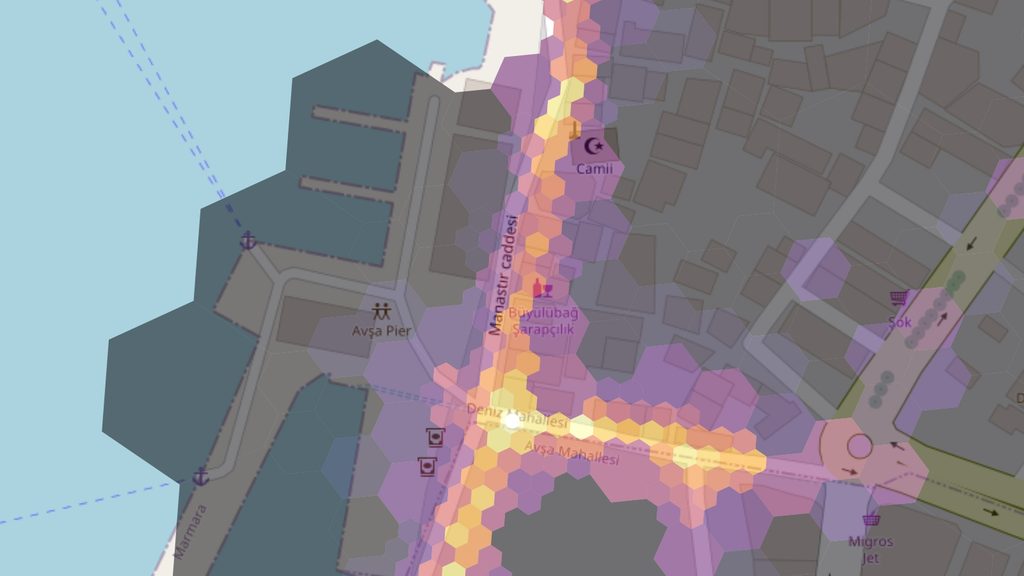
Avşa Island is one of the Sea of Marmara’s most popular summer retreats, and the busiest stretch of pedestrian activity clusters at the junction where Ömer Kaptan Caddesi meets Manastır Caddesi, just inland from Avşa Pier. The crossing sits at the natural meeting point between the ferry landing and the island’s main strip of restaurants, cafés, and local shops, pulling nearly all foot traffic through a single compact node. With more than 10,000 of its roughly 11,000 daily pedestrians counted as touristic, the data make clear that almost everyone here has come specifically for the island rather than passing through on the way to somewhere else.
6. Cumhuriyet Bulvarı, Akdeniz, Mersin, Mersin: 9,720 Daily Tourists
Cumhuriyet Bulvarı is Mersin’s main coastal boulevard running along the Mediterranean seafront in the Akdeniz district, and the peak footfall clusters along the pedestrian promenade between the boulevard’s two carriageways, near Sardunya Parkı. The stretch draws more than 11,000 people daily, with around 9,700 counted as touristic, reflecting the boulevard’s strong appeal as a leisure destination rather than a transit corridor. Mersin’s waterfront setting, with the sea on one side and a string of cafés, parks, and palm-lined walkways on the other, gives this stretch a relaxed character that pulls people specifically to linger rather than pass through.
7. 1. Cadde (First Street), Mardin, Mardin: 9,520 Daily Tourists
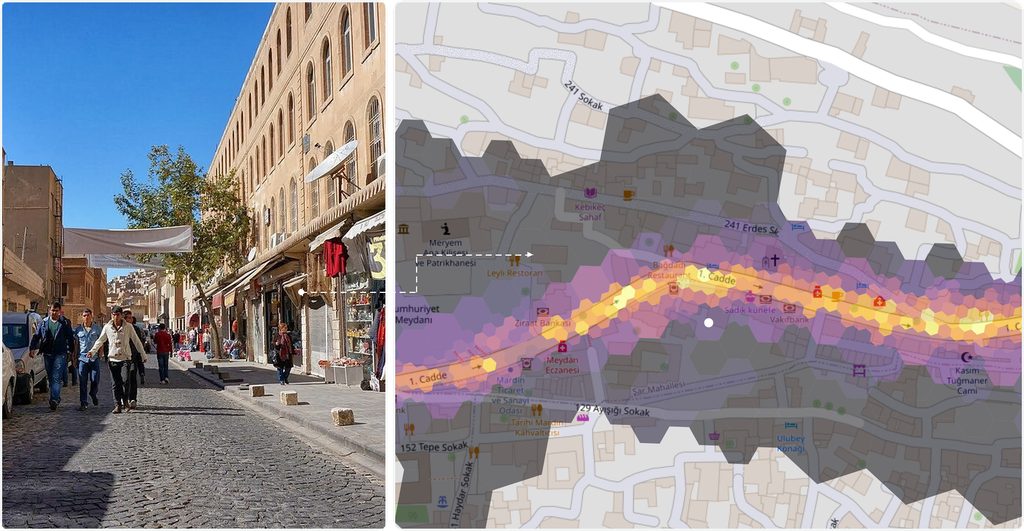
1. Cadde is the long stone-paved street that threads through the heart of Mardin’s old city, perched dramatically on a ridge above the Mesopotamian plain in the Artuklu district. The footfall peak sits along the central stretch near Cumhuriyet Meydanı, where restaurants, traditional craft shops, and historic han buildings line both sides of the narrow corridor, with landmarks such as Meryem Ana Kilisesi ve Patrikhanesi (Church and Patriarchate of the Virgin Mary) just steps to the north. With more than 9,500 of its roughly 12,000 daily pedestrians counted as touristic, the data reflect how strongly Mardin’s reputation for Syriac Christian heritage, Artuqid-era architecture, and distinctive honey-coloured stonework pulls people to this specific stretch. The surrounding lanes — including those leading down towards Kasım Tuğmaner Cami and the Ulubey Konağı — extend the catchment through a dense neighbourhood that rewards slow, unhurried exploration.
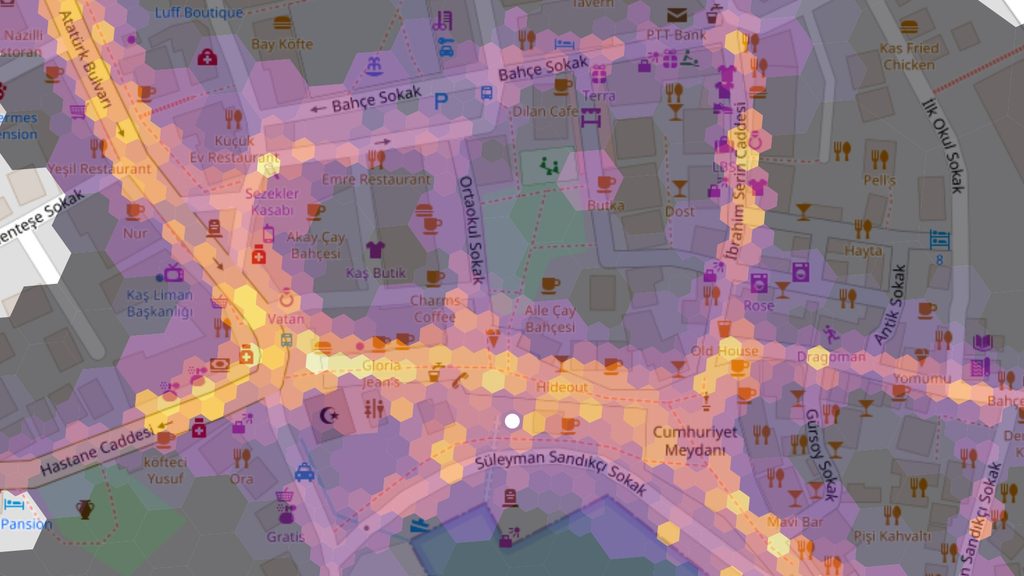
8. Atatürk Bulvarı, Kaş, Antalya: 8,830 Daily Tourists
Kaş is a small harbour town on the Lycian Coast where the foot traffic concentrates along Atatürk Bulvarı, particularly at the point where it intersects with Orta okul Sokağı and feeds towards Cumhuriyet Meydanı. The surrounding streets — including Süleyman Sandıkçı Sokağı curving down towards the waterfront and Bahçe Sokak to the north — are lined with restaurants, jewellery shops, and cafés that keep pedestrian numbers steady throughout the day. With around 8,800 of its roughly 11,000 daily pedestrians counted as touristic, the data reflect how strongly the town draws people who have come specifically for Kaş itself, rather than passing through on the way elsewhere.
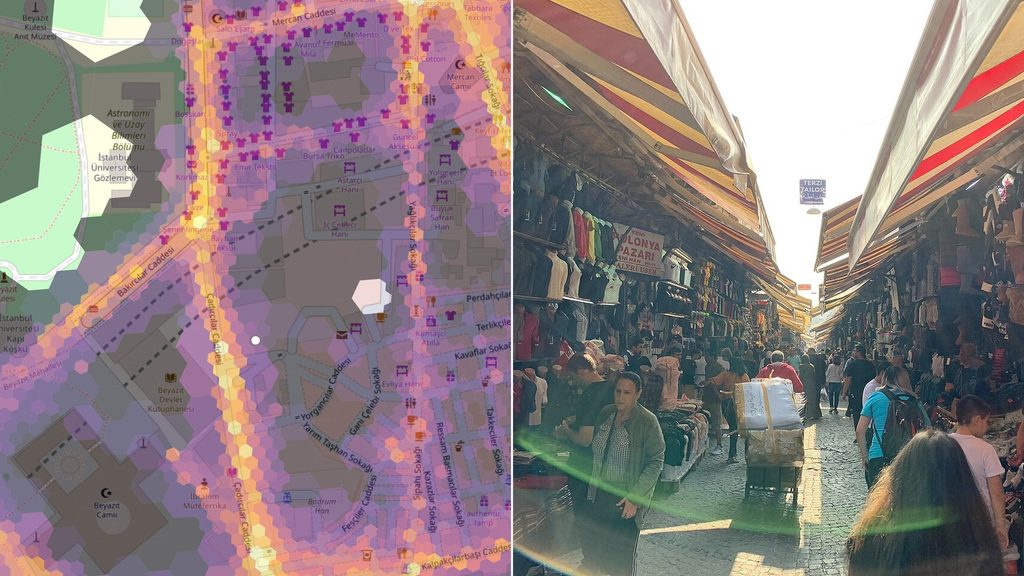
9. Çadırcılar Caddesi, Beyazıt, Istanbul: 8,300 Daily Tourists
Çadırcılar Caddesi runs through the Beyazıt quarter of Fatih, threading between Beyazıt Camii and the edges of the Grand Bazaar (Kapalı Çarşı) in one of the old city’s most historically layered neighbourhoods. The busiest stretch sits where the street passes alongside Beyazıt Devlet Kütüphanesi, with Bakırcılar Caddesi branching off to the north through a dense corridor of textile and wholesale traders. Beyazıt Square (Beyazıt Meydanı) and the main gate of Istanbul University lie just steps to the west, keeping a steady flow of people moving through this corridor throughout the day. With around 8,300 of its roughly 11,700 daily pedestrians counted as touristic, the data point clearly to how strongly this quarter’s proximity to the Grand Bazaar and its cluster of Ottoman monuments draws people who have come specifically to explore this part of the historic peninsula.
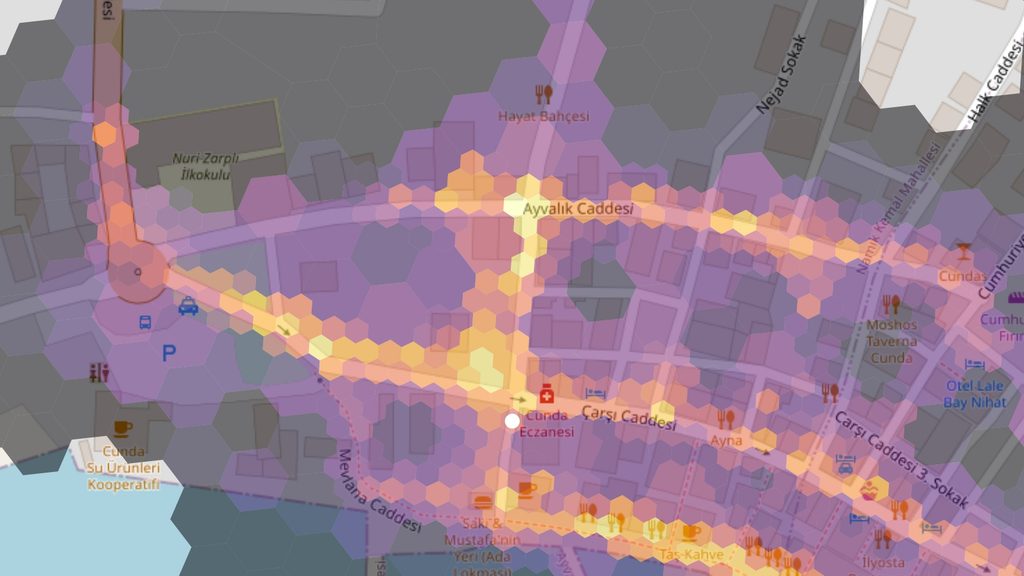
10. Çarşı Caddesi, Cunda Island, Balıkesir: 8,180 Daily Tourists
Cunda Island, connected to the mainland town of Ayvalık by a causeway, is one of the northern Aegean’s most characterful destinations, and the busiest stretch of pedestrian activity runs along Çarşı Caddesi near its junction with Mevlana Caddesi, close to Cunda Eczanesi. The street sits at the heart of the island’s old Greek quarter, where stone-built houses, meyhanes, and seafood restaurants line a compact waterfront grid that draws people specifically to linger. With around 8,200 of its roughly 10,800 daily pedestrians counted as touristic, the data confirm that this is a place people come to for its own sake rather than passing through.
Top 10 Shopping Malls in Türkiye by Daily Visitors
Istanbul and İzmir each claim multiple entries, with Forum Istanbul and Cevahir at the top end and three İzmir malls — Optimum İzmir, Forum Bornova, and İstinyePark İzmir — spread across the ranking, confirming both cities as the country’s deepest retail markets. Ankara and Antalya each produce a single high-performing mall, with ANKAmall and MarkAntalya demonstrating that strong catchment populations outside the major coastal metros can still generate competitive daily footfall. For expansion teams, ranking malls by measured visitor demand rather than floor area or brand profile makes it possible to identify which cities and specific centres offer the most reliable customer volumes before committing capital.
| City | Mall | Daily Visitors |
|---|---|---|
| Istanbul | Forum İstanbul Alışveriş ve Yaşam Merkezi | 42,060 |
| Ankara | ANKAmall | 41,410 |
| İzmir | İzmir Optimum | 36,230 |
| Istanbul | İstanbul Cevahir Alışveriş ve Eğlence Merkezi | 36,080 |
| Istanbul | Mall of Istanbul | 34,260 |
| Antalya | MarkAntalya | 31,780 |
| İzmir | Forum Bornova | 31,160 |
| Istanbul | Marmara Park | 30,390 |
| İzmir | İstinyePark İzmir | 29,870 |
| Izmir (İzmir) | Hilltown Karşıyaka | 26,190 |
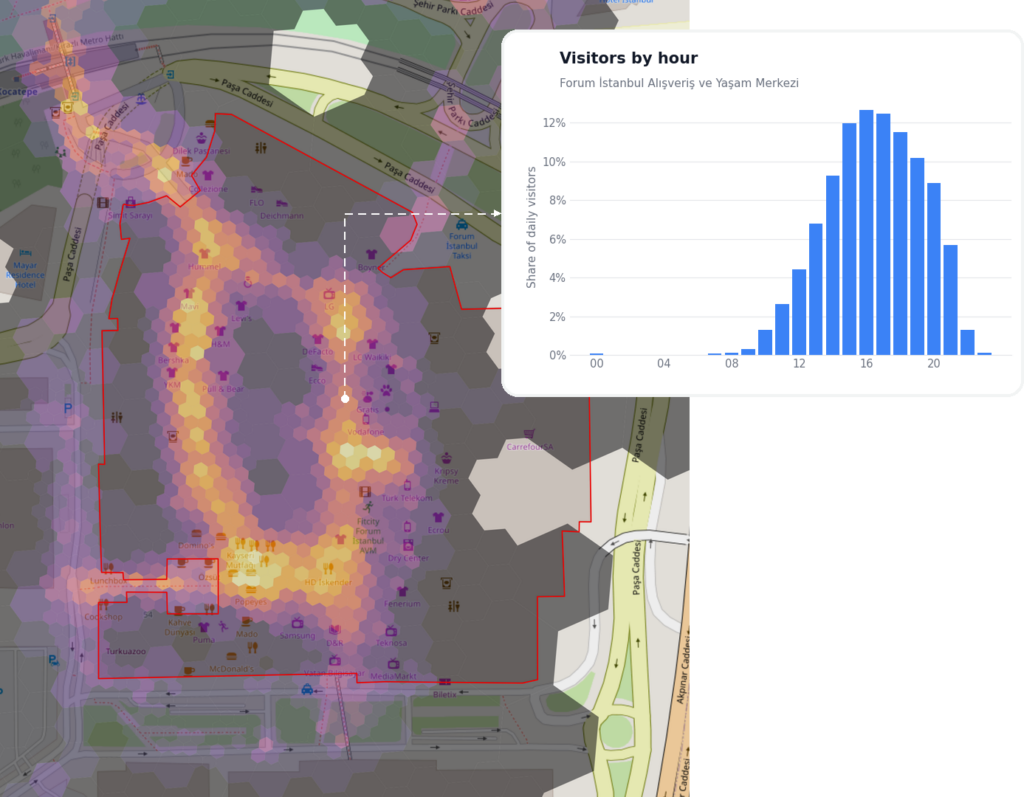
1. Forum İstanbul Alışveriş ve Yaşam Merkezi, Istanbul: 42,060 Daily Visitors
Forum Istanbul is the busiest shopping centre in Türkiye, drawing more than 42,000 visitors daily. Located in the Bayrampaşa district, it is one of the largest retail and lifestyle destinations in the country. The busiest activity clusters around the main central concourse, reflecting its role as a major hub for both shopping and leisure.
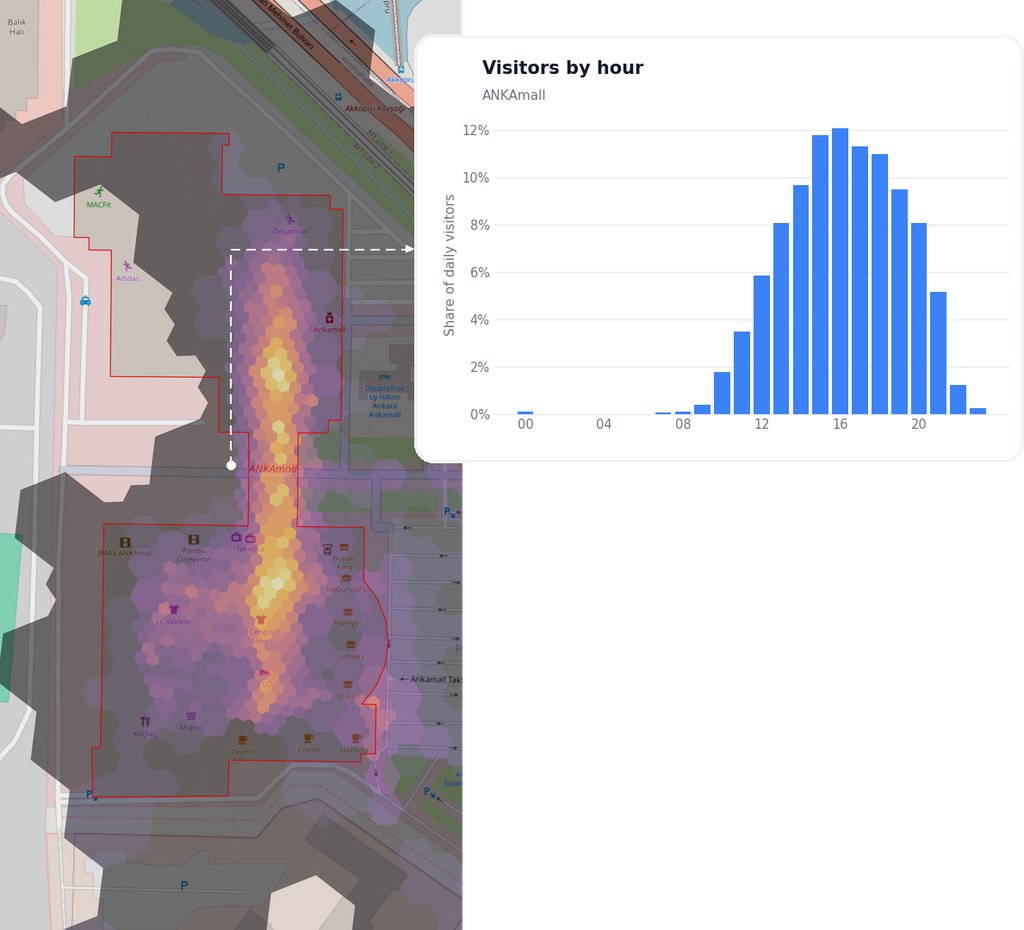
2. ANKAmall, Ankara: 41,410 Daily Visitors
ANKAmall is one of Ankara’s busiest shopping destinations, drawing more than 41,000 visitors on a typical day and ranking second in the country. Located in the Yenimahalle district, it attracts a broad mix of shoppers from across the capital. The heatmap shows the highest concentration of visitors clustered around the mall’s main entrances and central retail areas.
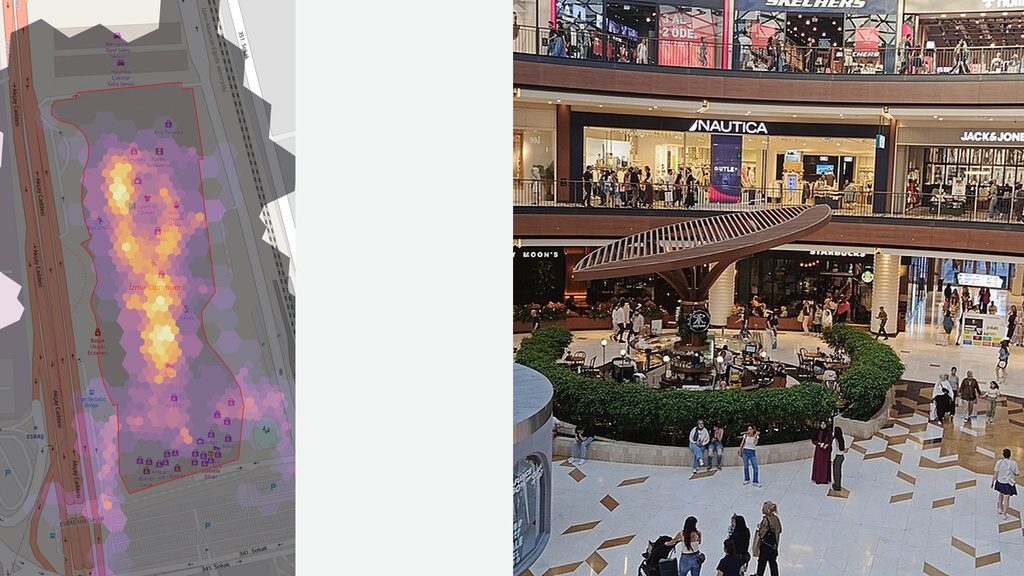
3. İzmir Optimum, İzmir: 36,230 Daily Visitors
Optimum İzmir sits in the Gaziemir district, positioned conveniently near İzmir’s main transport corridors. It ranks third in Türkiye by daily visitors, drawing an impressive figure of more than 36,000 people each day. The busiest activity clusters around the main retail entrance along Akçay Caddesi, reflecting its strong pull as one of the region’s leading shopping destinations.
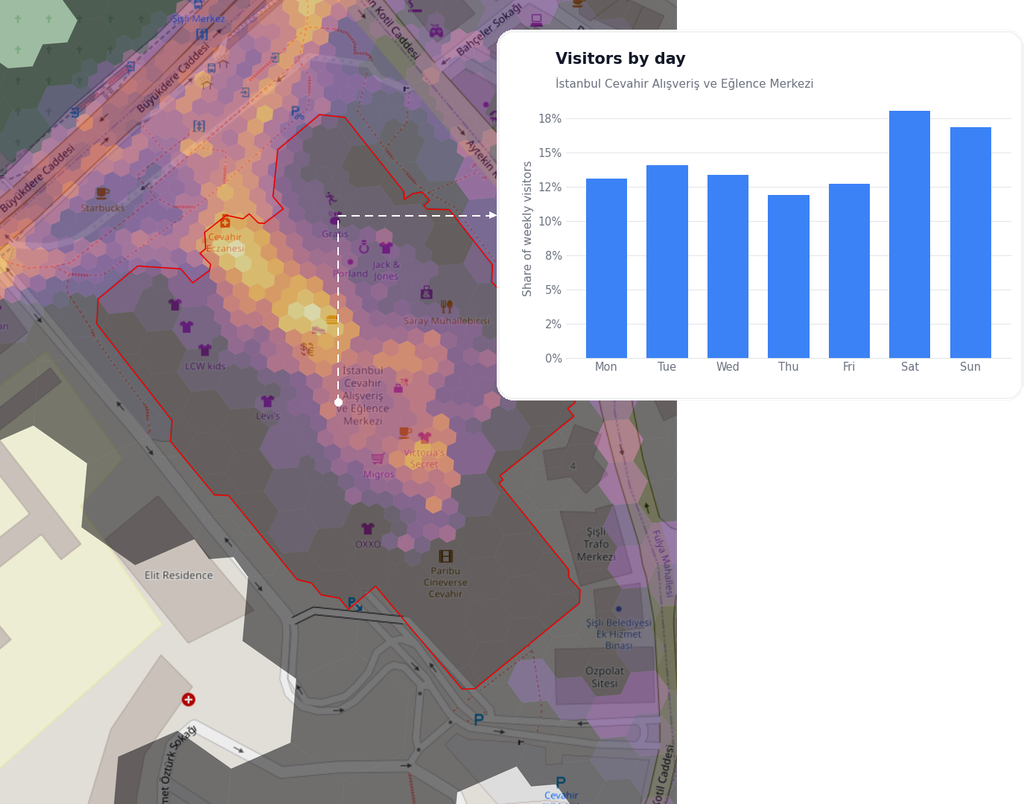
4. İstanbul Cevahir Alışveriş ve Eğlence Merkezi, Istanbul: 36,080 Daily Visitors
Cevahir Shopping Centre in the Şişli district is one of the largest shopping malls in Europe, spanning an enormous complex with hundreds of stores, dining outlets, and entertainment facilities. Visitors are most concentrated around the central atrium and the Starbucks near the 19 Mayıs entrance. It draws around 36,000 visitors daily, making it the fourth busiest shopping destination in Türkiye.
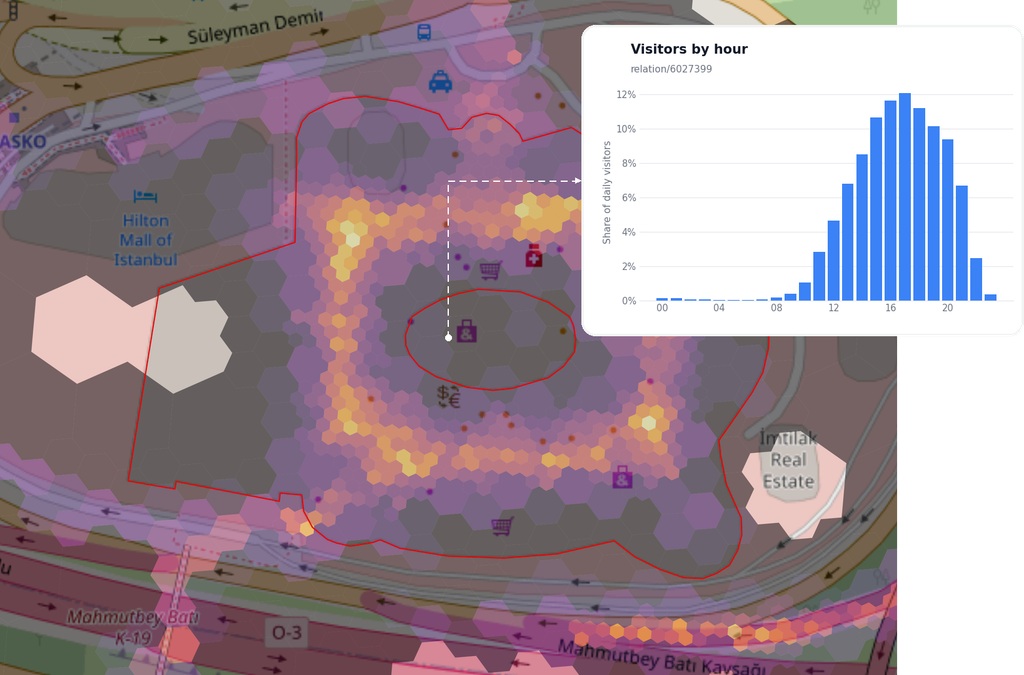
5. Mall of Istanbul, Istanbul: 34,260 Daily Visitors
Mango is one of Istanbul’s busiest retail destinations, ranking fifth in the country with around 34,000 daily visitors. Located on Süleyman Demirel Bulvarı in the Başakşehir district, the centre draws a strong and consistent flow of shoppers from across the wider metropolitan area. The busiest activity clusters around the main entrance zone along the boulevard frontage.
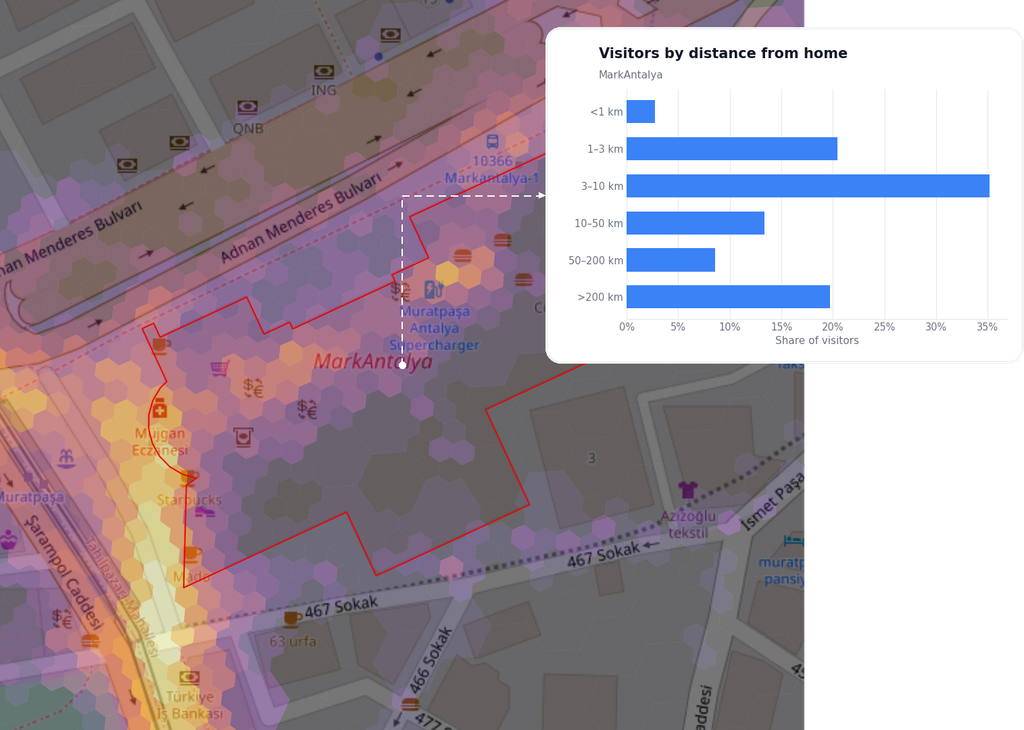
6. MarkAntalya, Antalya: 31,780 Daily Visitors
MarkAntalya is one of the busiest shopping centres in Turkey, drawing around 30,000 visitors daily. Located in the Muratpaşa district of Antalya, it ranks sixth nationwide for visitor numbers. The heatmap shows the highest concentration of activity centred tightly around the main entrance on Tahılpazarı.
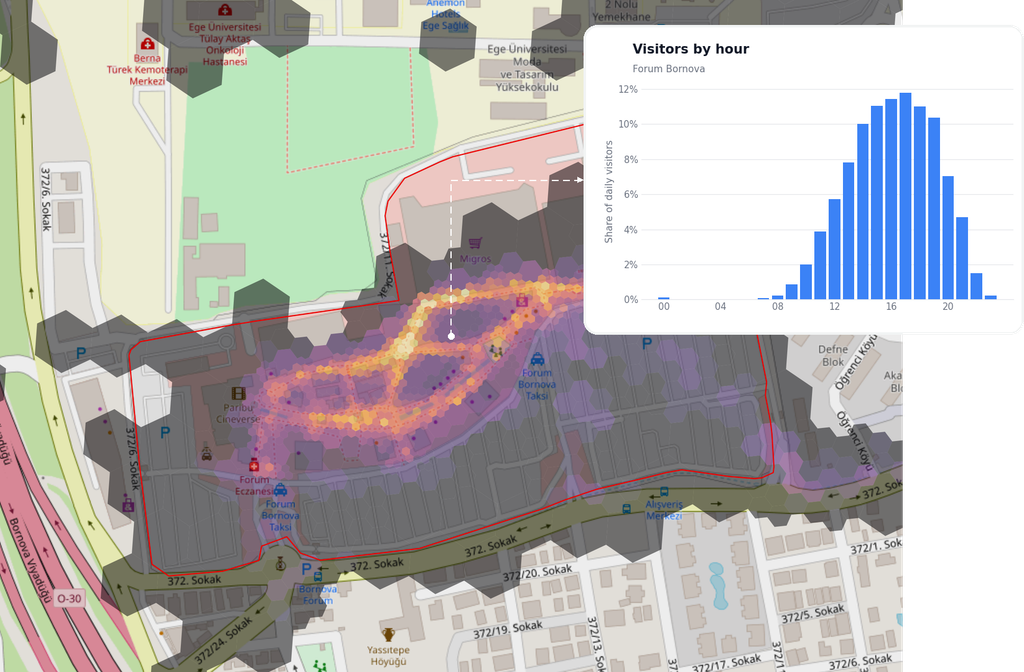
7. Forum Bornova, İzmir: 31,160 Daily Visitors
Forum Bornova is one of İzmir’s major retail destinations, located in the Bornova district on the city’s eastern side. The centre draws more than 31,000 visitors daily, ranking it seventh busiest among shopping centres across Türkiye. Visitor activity is most intense around the mall’s central concourse, reflecting its broad appeal as a shopping and leisure hub for the wider İzmir metropolitan area.
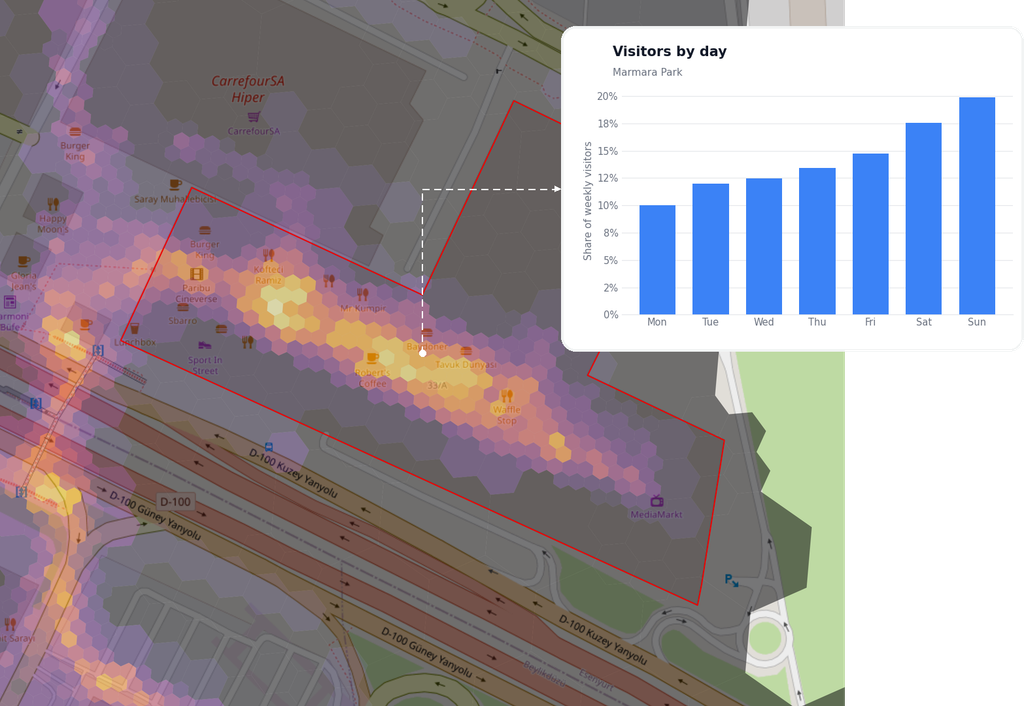
8. Marmara Park, Istanbul: 30,390 Daily Visitors
Marmara Park is a galactic-themed shopping centre in Esenyurt, on the E-5 Highway in one of Istanbul’s fastest-growing districts. Opened in October 2012 following a €220 million investment, it spans a leasable area of around 100,000 square metres — formerly home to the Tatilya amusement park — and houses more than 250 stores alongside parking for up to 4,000 vehicles. With around 4 million people living within its catchment area, it draws more than 30,000 visitors daily, placing it eighth in Türkiye.
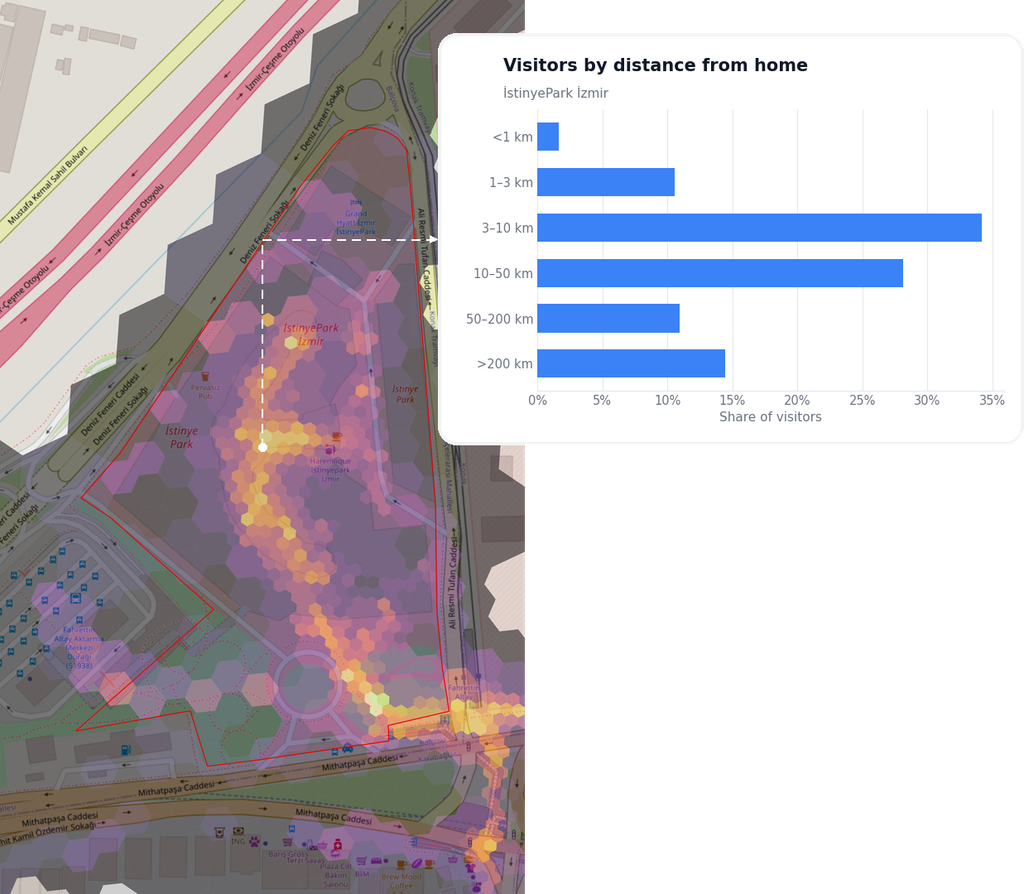
9. İstinyePark İzmir, İzmir: 29,870 Daily Visitors
İstinyePark İzmir is a large upscale shopping centre located in the Balçova district of İzmir. It draws close to 30,000 visitors daily, ranking it among the busiest retail destinations in Türkiye. The busiest activity clusters around the mall’s central retail corridors, reflecting its popularity as a premier shopping and leisure destination on the Aegean coast.
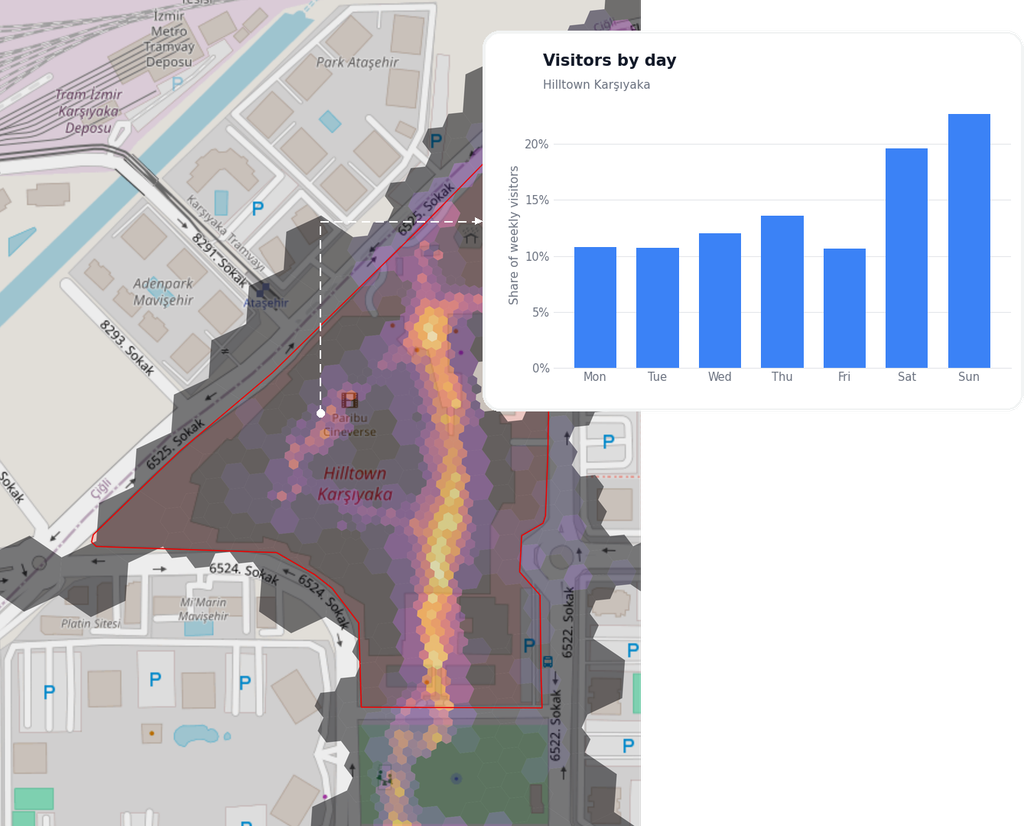
10. Hilltown Karşıyaka, Izmir: 26,190 Daily Visitors
Hilltown Karşıyaka is a large shopping centre in the Karşıyaka district on the northern shore of Izmir Bay. It draws more than 26,000 visitors daily, making it the tenth busiest shopping destination in Türkiye. The busiest activity concentrates around the main retail galleries at the heart of the complex.
Use Footfall Data to Make Smarter Retail Site Decisions
Footfall reveals where people move, which streets attract the most pedestrian activity, and how shopping centres compare by visitor volume. Yet the busiest location is not necessarily the right one for every retail concept. Effective site selection also requires an understanding of catchments, accessibility, local demographics, competitors and complementary POIs, and visitor behaviour.
With TargomoLOOP, expansion teams can examine these factors together and compare locations in context. Businesses that want to integrate location intelligence into their own systems can use TargomoAPI to access Targomo’s geospatial data and analysis capabilities.
Whether you are entering Türkiye for the first time or optimising an existing store network, combining granular Türkiye footfall data with tourism insights and a broader retail expansion strategy supports more informed decisions. Comparing streets, districts, and malls on a consistent basis helps retailers identify locations that fit their concept, customers, and growth plans—not simply those with the highest traffic.
Ready to explore better locations with Targomo’s Footfall Data?
Book a demo to see how TargomoLOOP can support retail site selection, market entry and network expansion.
You May Also Be Interested in